
With the global medicinal herbs market reaching a valuation of $253.60 billion in 2026, it’s evident that more people are seeking alternatives to the often harsh side effects of synthetic pharmaceuticals. You’ve likely felt the frustration of managing one symptom only to trigger another, or perhaps you’ve felt overwhelmed by the sheer volume of supplements available today. Understanding eastern herbal medicine isn’t about finding a natural pill for a quick fix; it’s about embracing a sophisticated, time-tested system that views your body as a complete, interconnected landscape.
This guide will provide the clarity you need to move from confusion to confidence, revealing the scientific foundations and ancient wisdom that drive long-term vitality. We’ll examine how new international standards like ISO 24063:2026 and updated production regulations are ensuring higher quality and safety for patients across the globe. Consequently, you’ll gain a clear grasp of traditional healing philosophies and a practical path toward professional consultation in New Jersey, allowing you to make informed decisions for your unique health journey.
Key Takeaways
- Understand the foundational principles of eastern herbal medicine, a system designed to restore internal equilibrium rather than merely suppressing symptoms.
- Explore the vital roles of Qi, Yin-Yang, and the Five Elements in maintaining physiological function and emotional balance.
- Learn how the “Emperor, Minister, Assistant, and Envoy” hierarchy creates synergistic herbal formulas tailored to your unique needs.
- Discover the modern safety protocols, including third-party testing for heavy metals, that guarantee the quality and purity of botanical remedies.
- Develop a structured wellness plan that integrates ancient healing traditions with your contemporary diet, sleep, and stress management routines.
What is Eastern Herbal Medicine? Defining the Path to Natural Vitality
Eastern herbal medicine represents a sophisticated medical system with a history spanning more than 2,500 years. It isn’t just about plants; it’s a philosophy that views the human body as a reflection of the natural world, where health is defined by the seamless flow of energy and the balance of internal systems. While many modern treatments focus on suppressing specific symptoms, the fundamental objective of this tradition is to restore internal equilibrium. By addressing the underlying disharmony, practitioners help the body return to its natural state of vitality.
In practice, a qualified practitioner doesn’t simply prescribe a remedy based on a single complaint. They conduct a thorough assessment to identify the root cause of an ailment. This diagnostic process is what separates professional Traditional Chinese Medicine from casual home remedies or Western “folk” medicine. It requires a deep understanding of how different systems within the body interact and affect one another.
The Historical Heritage of Traditional Healing
The evolution of these practices began with foundational texts like the “Shennong Ben Cao Jing,” which categorized hundreds of botanical substances. Over centuries, clinicians gathered vast amounts of observational data, refining their understanding of how specific plants impact human physiology. Today, herbal medicine has transitioned into a highly regulated global wellness landscape. As of March 1, 2026, the implementation of the “Special Provisions for Supervision and Administration of Traditional Chinese Medicine Production” has established rigorous standards for quality control and digital traceability, ensuring that ancient wisdom meets modern safety expectations.
Eastern vs. Western Herbalism: Key Differences
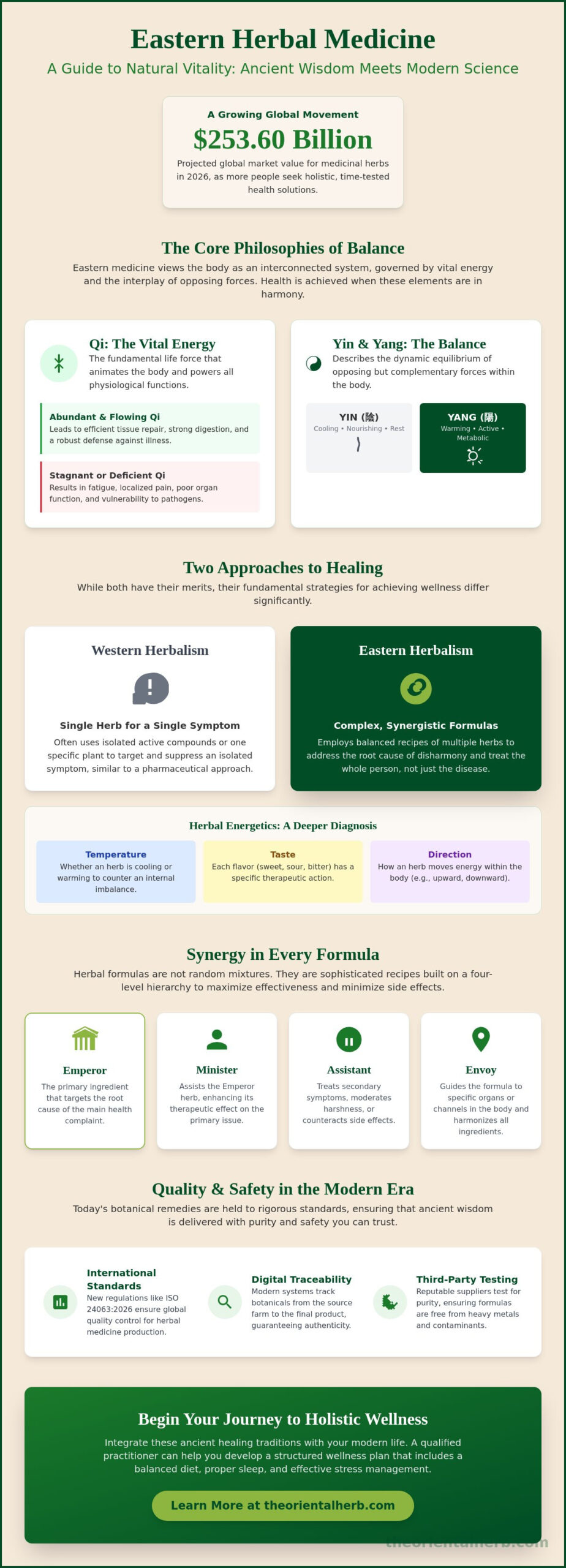
Western herbalism often utilizes a “single herb for a single symptom” approach, similar to how one might take an aspirin for a fever. In contrast, eastern herbal medicine relies on complex, synergistic formulas. These recipes account for the energetic properties of each ingredient, including:
- Temperature: Whether an herb is cold, cool, neutral, warm, or hot.
- Taste: The specific therapeutic actions of sour, bitter, sweet, pungent, or salty flavors.
- Direction: How the herb moves energy within the body, such as upward or downward.
This method treats the individual person rather than just the disease. It acknowledges that two people with the same symptom might require entirely different formulas based on their unique internal landscapes. This personalized focus ensures that the treatment supports the whole body, fostering resilience that lasts long after the initial symptoms have faded.
The Core Philosophies: Qi, Yin-Yang, and the Five Elements
At the heart of eastern herbal medicine lies a collection of philosophies that, while ancient, provide a remarkably precise map of human physiology. These concepts aren’t merely abstract theories; they’re functional descriptions of how the body maintains life and recovers from illness. By understanding these frameworks, you can better appreciate how specific botanical formulas work to restore your natural vitality. Most importantly, these principles help bridge the gap between subjective feelings of unwellness and objective clinical strategies.
The most foundational of these concepts is Qi (pronounced “chee”). In a clinical setting, practitioners view Qi as the vital energy responsible for maintaining all physiological functions. When your Qi is abundant and moving freely, your body possesses the necessary resources to repair tissues, digest food, and defend against pathogens. Conversely, health issues arise when this energy becomes stagnant or deficient. For instance, a person might experience chronic fatigue due to a lack of Qi or localized pain because the flow has been obstructed. Research into the safety and effectiveness of TCM suggests that many traditional practices aim to optimize these internal processes through targeted interventions.
Complementing Qi is the principle of Yin and Yang, which describes the balance of opposing forces within the body. Yang represents the warming, active, and metabolic functions, while Yin represents the cooling, nourishing, and resting aspects. Health is a dynamic state of equilibrium between these two. If Yang becomes excessive, you might feel restless or experience inflammation. If Yin is depleted, you may suffer from night sweats or a sense of “empty heat.” These aren’t just metaphors; they correspond to tangible physical sensations that guide a practitioner’s choice of treatment and lifestyle recommendations.
Understanding the Flow of Qi
In a modern context, Qi is best understood as a combination of metabolism, blood circulation, and immune resilience. When we use herbal medicine for health issues, the goal is often to unblock or nourish this flow. It’s also vital to recognize the link between your emotional state and Qi movement. Stress and frustration frequently lead to “Qi stagnation,” which can manifest as digestive upset or tension headaches. By addressing these energetic blocks, herbal protocols help the body regain its natural rhythm and resilience.
The Five Element Theory in Clinical Practice
The Five Element theory categorizes the body’s organ systems into five functional groups: Wood, Fire, Earth, Metal, and Water. Each element corresponds to specific organs and physiological processes. For example, the Wood element relates to the liver’s role in smooth energy flow, while Earth relates to the spleen’s digestive functions. Practitioners use this map to identify which systems are under-supported and how one imbalance might lead to another. This system creates a predictive model for long-term health, allowing for preventive care that addresses weaknesses before they manifest as chronic disease. If you’re looking to explore these methods further, consulting with a knowledgeable professional can help you identify your specific constitutional needs.
The Art of Formulation: Why Synergy Matters in Eastern Medicine
The efficacy of eastern herbal medicine doesn’t rely on a single miracle ingredient. Instead, it draws its strength from the strategic combination of multiple botanicals. This concept, known as synergy, ensures that the whole formula is significantly more powerful than the sum of its individual parts. While some modern approaches isolate active compounds for a quick fix, traditional practitioners utilize complex chinese herbal formulas that have been refined over thousands of years to address multifaceted physiological imbalances. By combining herbs with complementary properties, we can enhance therapeutic outcomes while minimizing potential sensitivities.
A core component of this art is “Dui Yao,” or the practice of pairing specific herbs to amplify their benefits or neutralize their harshness. These pairs serve as the fundamental building blocks for larger, more intricate prescriptions. By layering these combinations, a practitioner can target the root cause of an issue while simultaneously supporting the body’s overall resilience. This sophisticated approach aligns with the core philosophies of Chinese Medicine, which emphasize the interconnectedness of all bodily systems and the importance of systemic harmony.
The Hierarchy of a Traditional Formula
To maintain order and efficacy, every formula follows a strict organizational structure. The Emperor herb is the most critical component, as it directly targets the primary health concern. Supporting this is the Minister, which strengthens the Emperor’s effect and addresses secondary symptoms. Specifically, the Assistant herb plays a dual role by reducing any potential side effects of the stronger herbs and providing additional support. Finally, the Envoy acts as a guide, ensuring the medicinal properties reach the specific organs or channels that require treatment.
Customization for the Individual
A significant advantage of this system is its inherent flexibility. When a patient in Fort Lee or Teaneck seeks professional guidance, their practitioner doesn’t simply reach for a generic bottle. They modify a base formula to match the patient’s current state, environment, and constitution. As your health improves or symptoms shift, the practitioner adjusts the ratios and ingredients accordingly. A formula is a “living” prescription tailored to your unique biology.
This level of precision is why practitioner-prescribed formulas differ so greatly from “ready-made” supplements found in health stores. Mass-produced products are designed for a broad audience and cannot account for the subtle nuances of your internal landscape. Understanding the key distinctions when evaluating chinese herbal formulas vs single herbs can help clarify why a customized multi-ingredient prescription consistently outperforms isolated botanical supplements for complex health concerns. By receiving a customized prescription, you ensure that the eastern herbal medicine you consume is both safe and optimized for your specific recovery path, leading to more sustainable results.
Safety, Quality, and Sourcing in the Modern Era
The primary concern for many individuals exploring eastern herbal medicine is the issue of purity and safety. It’s a valid question: how can you trust that the botanicals you consume are free from contaminants? In 2026, the industry has reached a new level of transparency. As of March 1, 2026, the implementation of the “Special Provisions for Supervision and Administration of Traditional Chinese Medicine Production” has established rigorous standards for quality control and digital traceability. These regulations ensure that herbal extracts and formula granules meet strict safety benchmarks before they reach the patient.
When you’re sourcing remedies independently, you must be diligent. High-quality practitioners only utilize herbs that have undergone third-party testing for heavy metals, pesticides, and microbial content. This level of scrutiny is essential for maintaining the integrity of the treatment. If you’re looking for guidance on your own, use this checklist for vetting traditional chinese medicine online stores:
- Certificate of Analysis (COA): Ensure the provider can supply a COA for every batch of herbs.
- GMP Certification: Only purchase from facilities that follow Good Manufacturing Practices.
- Full Disclosure: Avoid products that use “proprietary blends” without listing specific ingredients and concentrations.
- Sourcing Transparency: Look for brands that specify where their herbs are grown and harvested.
Identifying High-Quality Herbal Products
Understanding the label is your first line of defense. A professional-grade product will always include the Latin binomial name of the plant to ensure botanical accuracy. There’s also a significant difference between “food grade” herbs found in grocery stores and “medicinal grade” substances used in clinical practice. Medicinal grade herbs are tested for specific potency levels of active constituents. This is why professional-grade oriental herbal supplements are consistently superior to generic retail brands; they’re designed for therapeutic efficacy rather than just general wellness marketing.
The Role of Professional Guidance
While access to herbs has increased, the need for expert oversight has never been greater. Michael Kim’s 30+ years of experience in Bergen County provides a foundation of safety that self-prescribing simply cannot match. A primary benefit of professional consultation is the management of potential herb-drug interactions. An integrative approach ensures that your herbal protocol doesn’t interfere with any conventional medications you may be taking. For residents in Ridgefield and North Bergen, accessing this expertise is a straightforward path to ensuring your health journey is both safe and effective. If you’re ready to move beyond generic options, schedule a professional assessment to secure a protocol tailored specifically to your safety needs.
Integrating Eastern Wisdom into Your 2026 Wellness Routine
Transitioning from an understanding of ancient theory to a practical health plan requires a shift in perspective. Eastern herbal medicine is most effective when it’s treated as a foundational pillar of your daily life rather than a sporadic intervention. To achieve natural, long-term vitality, you must align your herbal protocol with consistent lifestyle choices. This includes mindful attention to your diet, sleep hygiene, and stress management, as these factors directly influence the efficacy of any botanical formula. When your external habits support your internal landscape, the path to equilibrium becomes much clearer.
Your journey toward better health starts with a commitment to the process. It’s common to feel eager for immediate results, yet true healing often unfolds gradually as the body’s systems regain their natural rhythm. By moving from curiosity to a structured health plan, you ensure that every step you take is purposeful and grounded in professional expertise. This methodical approach helps you avoid the confusion of self-prescribing and allows for a more profound connection with your own physiological needs.
Practical Steps for Beginners
If you’re ready to begin, start by identifying a specific health goal, such as improving digestive resilience or enhancing your overall energy levels. Keeping a health journal is an excellent way to track subtle changes in your Qi and overall balance. Note your energy fluctuations, sleep quality, and emotional state; these observations provide invaluable data for your practitioner. If disrupted rest is among your concerns, understanding the science behind herbal remedies for sleep can help you separate fact from fiction before your first consultation. Most importantly, always consult with a specialist before combining new herbs with your existing medical regimen. This ensures that your integrative approach remains safe and optimized for your unique biology.
Your Local Resource for Eastern Medicine
Since 1995, The Oriental Natural Herbs has served as a stable and knowledgeable mentor for the community. We’ve dedicated decades to bridging the gap between historical wisdom and the contemporary needs of our neighbors. Our heritage is rooted in a deep sense of responsibility to the public health of residents in Englewood, Fairview, and the broader Union County area. We believe that everyone deserves access to high-quality, professional-grade botanical care that honors the traditions of the past while meeting the safety standards of 2026.
During your first consultation, we’ll conduct a comprehensive assessment of your constitutional type and current health status. This isn’t just a review of your symptoms; it’s a deep dive into the root causes of your concerns. We’ll discuss your history, observe your vital signs, and develop a customized strategy that empowers you to take control of your well-being. We invite you to join our community of seekers focused on longevity and vitality. Schedule a consultation with Michael Kim today to begin your journey toward a more balanced and vibrant life.
Empowering Your Path to Sustainable Vitality
Adopting a holistic health strategy involves more than just selecting a natural supplement; it requires a deep understanding of how synergistic formulas and energetic balance foster long-term resilience. You’ve seen how the sophisticated principles of Qi and Yin-Yang provide a map for internal harmony, and how modern quality standards now ensure the purity of every botanical ingredient. By choosing eastern herbal medicine, you’re embracing a tradition that’s been refined over millennia to support the body’s innate ability to heal and thrive.
Since 1995, we’ve provided this stable and authoritative expertise to the communities of Bergen and Union Counties. We prioritize patient safety through high-quality, third-party tested formulations that meet the rigorous expectations of the current era. Begin your journey to natural health with a professional consultation at The Oriental Natural Herbs. Under the dedicated guidance of Michael Kim, a Licensed Acupuncturist and Diplomate of Oriental Medicine, you can move forward with the confidence that your wellness plan is as unique as your own biology. We look forward to supporting your transition toward a more vibrant and balanced life.
Frequently Asked Questions
What is the primary difference between Eastern and Western medicine?
Eastern medicine primarily differs from Western medicine by focusing on the whole person and internal balance rather than just suppressing isolated symptoms. Practitioners view the body as an interconnected system where health depends on the seamless flow of energy. While Western approaches often rely on isolated chemical compounds, Eastern traditions utilize synergistic formulas to address the root cause of disharmony. This holistic perspective allows for a more comprehensive understanding of a patient’s unique physiological landscape.
Are Eastern herbal remedies safe to take with my prescription medications?
Many herbal remedies are safe to use alongside prescriptions, but professional guidance is essential to manage potential herb-drug interactions. An integrative approach ensures that your botanical protocol complements rather than interferes with conventional treatments. You should always provide a full list of your current medications during your consultation. This transparency allows your practitioner to adjust formulas for maximum safety and efficacy, protecting your long-term health and well-being.
How long does it typically take to see results with herbal medicine?
The timeline for results varies based on the nature of your condition, but most patients observe subtle shifts within two to four weeks of consistent use. Acute issues may resolve more rapidly; however, chronic imbalances often require several months of treatment to achieve lasting stability. Consistency in both formula intake and lifestyle alignment is the most significant factor in determining the speed and sustainability of your recovery journey.
Do I need to see a practitioner, or can I buy herbs online myself?
A professional consultation is necessary to receive a formula tailored to your specific constitutional needs and to ensure safety. While many products are available online, self-prescribing carries risks because generic supplements cannot account for the subtle nuances of your internal landscape. A licensed expert ensures that the eastern herbal medicine you consume is medicinal grade and appropriate for your unique biological state, providing a much higher level of efficacy.
What health issues can Eastern herbal medicine effectively address?
This system effectively addresses a wide range of concerns, including digestive disorders, respiratory issues, hormonal imbalances, and chronic pain. Because the focus of eastern herbal medicine is on restoring systemic equilibrium, it’s particularly useful for complex conditions that involve multiple symptoms. By identifying the root disharmony, practitioners develop protocols that support the body’s natural healing capacity. This approach fosters resilience that lasts long after the initial symptoms have faded.
How are the herbs at The Oriental Natural Herbs sourced and tested for safety?
We source our botanicals from suppliers that adhere to strict Good Manufacturing Practices and provide comprehensive third-party testing results. Every batch is screened for heavy metals, pesticides, and microbial contaminants to ensure absolute purity and potency. This commitment to quality control reflects our dedication to patient safety and our confidence in the efficacy of the methods we’ve provided to the Bergen County community since 1995.
Can Eastern medicine help with chronic fatigue and low energy?
Eastern medicine addresses chronic fatigue by identifying and nourishing specific deficiencies in your vital energy, or Qi. Fatigue is often a sign of stagnant or depleted resources within the body; therefore, treatment focuses on unblocking energy pathways and strengthening organ systems. Through a combination of targeted formulas and lifestyle adjustments, patients can regain their natural vitality. This process builds a stable foundation for health that prevents future energy depletion.
Is acupuncture always necessary when taking herbal formulas?
Acupuncture is not always necessary, but it’s often recommended as a complementary therapy to enhance the results of herbal medicine. While herbal formulas work internally to nourish and balance the body, acupuncture works externally to regulate energy flow through specific channels. Using both methods together frequently leads to faster and more sustainable outcomes. However, many patients achieve significant health improvements by using professionally prescribed herbal protocols as their primary treatment. For those whose primary concern is restoring restful nights, exploring plant-based herbal remedies for sleep disorders offers a deeper look at how botanical synergy can address the root causes of insomnia without the side effects of conventional aids.