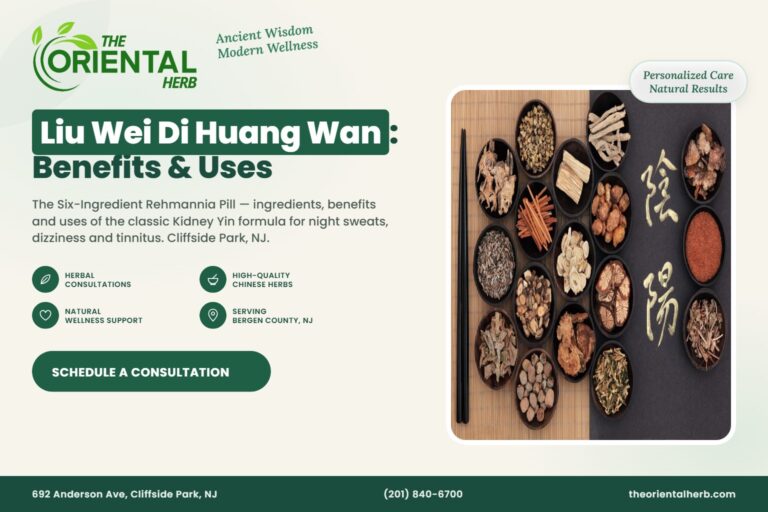
Ask a Chinese herbalist to name the single most important tonic formula and many will say Liu Wei Di Huang Wan – the Six-Ingredient Rehmannia Pill. It was composed by the pediatrician Qian Yi in the 11th century, originally for children who were developing slowly, and over the following nine centuries it became the foundation of Kidney Yin treatment for adults of every age. It is the base of at least a dozen famous variations, is manufactured by nearly every Chinese patent-medicine company, and sits on the shelf of our Cliffside Park herb store as one of the formulas we are asked about most.
What Liu Wei Di Huang Wan Is For
The formula nourishes Kidney and Liver Yin – the body’s cooling, moistening reserves. It is for people who are, in TCM terms, “running dry and overheating from within.” Typical signs:
- Low back soreness and weak knees
- Dizziness and tinnitus (ringing in the ears)
- Night sweats; heat in the palms and soles in the evening
- Dry mouth and throat, especially at night; thirst
- Restless sleep, waking in the early hours
- Hair loss, loose teeth, declining vision with age
- A red tongue with little coating; a thin, rapid pulse
It is used widely in menopause, in older adults, in people depleted by chronic illness or overwork, and as a long-term support in conditions such as type 2 diabetes and hypertension where a Yin-deficient pattern is present.
The Six Ingredients
The genius of the formula is its “three tonics, three drainers” structure – each nourishing herb is paired with a herb that prevents it from becoming cloying:
- Shu Di Huang (Prepared Rehmannia) – the chief herb; nourishes Kidney Yin and essence.
- Shan Zhu Yu (Cornus) – nourishes the Liver, astringes essence.
- Shan Yao (Chinese Yam) – strengthens the Spleen and Kidney.
- Ze Xie (Alisma) – drains Kidney dampness and clears deficiency heat.
- Mu Dan Pi (Moutan Bark) – cools the Liver and moves Blood.
- Fu Ling (Poria) – drains Spleen dampness.
Famous Variations
- Zhi Bai Di Huang Wan – adds Zhi Mu and Huang Bai for strong deficiency heat: hot flashes, night sweats. See Chinese herbs for menopause.
- Qi Ju Di Huang Wan – adds goji and chrysanthemum for dry eyes and blurred vision. See Chinese herbs for eye health.
- Mai Wei Di Huang Wan – adds Mai Dong and Wu Wei Zi for dry cough and Lung Yin deficiency.
- Er Long Zuo Ci Wan – adds magnetite and Acorus for tinnitus. See Chinese herbs for tinnitus.
- Jin Gui Shen Qi Wan – adds cinnamon and aconite to warm Kidney Yang; the opposite pattern (cold, fatigue, frequent urination).
How It Is Taken
Most commonly as small concentrated pills (typically 8 pills, two to three times daily) or granules. Yin builds slowly: a course is usually three months or longer, and many older adults take it as an ongoing tonic through the drier autumn and winter months.
Who Should Not Take It
- People with weak digestion, bloating and loose stools – Rehmannia is heavy; the formula may need Spleen herbs added.
- Anyone with a cold, flu or acute infection – tonics are paused until it clears.
- People who are actually Yang-deficient (cold, pale, sluggish) – they need the warming version instead.
- Always tell your practitioner about diabetes medication, blood pressure medication and anticoagulants.
Frequently Asked Questions
Is Liu Wei Di Huang Wan good for the kidneys?
It supports the TCM Kidney system – reserves, back, ears, hormones – not kidney disease. Kidney disease needs medical care; the formula may be used alongside it under guidance. Our guide to Kidney deficiency in Chinese medicine explains the difference.
Can men take it?
Absolutely – it is one of the most prescribed formulas for men with low back weakness, night sweats and fatigue from overwork.
How do I know if I need Liu Wei Di Huang Wan or Jin Gui Shen Qi Wan?
Heat signs (night sweats, dry mouth, red tongue) point to Liu Wei; cold signs (cold limbs, frequent clear urination, pale tongue) point to Jin Gui. A short consultation settles it.
Talk to a Chinese herbal practitioner in Cliffside Park, NJ. The Oriental Herb has served Bergen County since 1995 with personalized herbal consultations and high-quality Chinese herbs. Book a consultation, call (201) 840-6700, or visit our Chinese herb store at 692 Anderson Ave.
This article is for educational purposes only and is not medical advice. Chinese herbs are not a replacement for diagnosis or treatment from your physician. Always tell your doctor and your herbalist about every medication and supplement you take.