
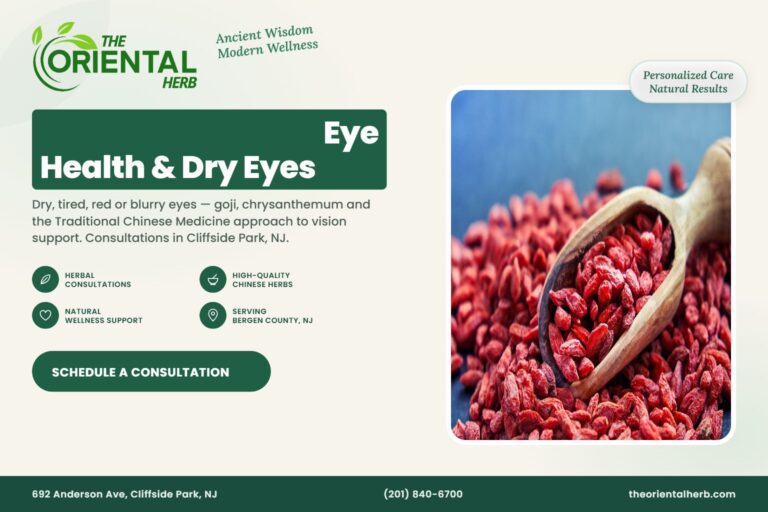
Most of us now spend eight to ten hours a day looking at screens, and our eyes are paying for it: dryness, grittiness, redness, blurred vision by evening and headaches behind the eyes. Add age-related changes and seasonal allergies, and eye complaints have become one of the fastest-growing reasons people visit our Cliffside Park herb store. Traditional Chinese Medicine (TCM) has a rich tradition of eye care, and several Chinese herbs for eye health – goji berry and chrysanthemum above all – are so safe they are consumed daily as tea.
The Eyes and the Liver
In TCM, the Liver opens into the eyes. The Liver stores Blood, and when you rest, Blood returns to the Liver and nourishes the eyes. Overwork, late nights and staring at screens “use up” Liver Blood, leaving the eyes dry and tired. The Kidney, which shares a root with the Liver, supports long-term vision. Heat and wind in the Liver channel cause redness, itching and irritation.
Common Eye Patterns
- Liver Blood deficiency – dry eyes, blurred vision when tired, floaters, difficulty focusing in dim light, often with pale nails and brittle hair.
- Liver and Kidney Yin deficiency – chronic dryness, declining vision with age, dizziness, night sweats.
- Liver heat or Liver fire – red, painful, gritty eyes; headaches; irritability.
- Wind-heat – acute itching, watering and redness from allergies or infection.
Chinese Herbs Commonly Used for Eye Health
Gou Qi Zi (Goji Berry)
The classic eye herb. Goji nourishes Liver and Kidney Yin and “brightens the eyes”; it is rich in zeaxanthin, the pigment concentrated in the macula. A handful in tea or soup is a traditional daily habit.
Ju Hua (Chrysanthemum Flower)
Cools Liver heat and clears the eyes; the go-to tea for red, tired eyes after screen work. Goji and chrysanthemum together are the most famous TCM eye tea.
Jue Ming Zi (Cassia Seed)
“Bright-vision seed” – clears Liver heat and is roasted and drunk as tea for eye strain and headaches.
Mi Meng Hua (Buddleia Flower) and Gu Jing Cao (Pipewort)
Traditional herbs for red, painful eyes with sensitivity to light.
Shu Di Huang, Shan Zhu Yu and Bai Shao
Blood and Yin tonics in formulas for dryness and declining vision.
Sang Ye (Mulberry Leaf) and Bo He (Mint)
Light, cooling herbs for itchy, watery allergic eyes.
Classic Formulas
- Qi Ju Di Huang Wan – Six-Ingredient Rehmannia plus goji and chrysanthemum; the most prescribed TCM eye formula for dryness and blurred vision from Yin deficiency.
- Ming Mu Di Huang Wan – a stronger “bright-eyes” version for age-related decline.
- Sang Ju Yin – mild wind-heat with red, itchy eyes.
- Si Wu Tang – Liver Blood deficiency with dry eyes and fatigue.
Daily Eye Care From TCM
- Follow the 20-20-20 rule: every 20 minutes look 20 feet away for 20 seconds.
- Drink goji and chrysanthemum tea in the afternoon.
- Eat dark leafy greens, carrots, black sesame and egg yolk – Blood-nourishing, carotenoid-rich foods.
- Palming: rub your hands warm and rest them over closed eyes for a minute.
- Sleep before 11 p.m. – the hours when Blood returns to the Liver.
When to See an Eye Doctor
Sudden vision loss, flashes of light, a curtain over part of your vision, severe eye pain, or a red eye after injury are emergencies. Anyone over 40 should have regular eye exams for glaucoma, cataract and macular degeneration; herbs support eye health but do not treat these conditions.
Frequently Asked Questions
Does goji berry really help eyesight?
Goji contains zeaxanthin and has been studied for macular pigment density; in TCM it has been the primary eye tonic for centuries. It is safe for most people, though it may interact with warfarin.
Can Chinese herbs help dry eyes from contact lenses or screens?
Yes – the Blood- and Yin-nourishing formulas above are specifically for that pattern, alongside lubricating drops.
How does this connect to headaches?
Eye strain and Liver heat often produce headaches together; a formula that cools the Liver tends to help both. Stress is usually part of the picture – see our anxiety and stress page.
Talk to a Chinese herbal practitioner in Cliffside Park, NJ. The Oriental Herb has served Bergen County since 1995 with personalized herbal consultations and high-quality Chinese herbs. Book a consultation, call (201) 840-6700, or visit our Chinese herb store at 692 Anderson Ave.
This article is for educational purposes only and is not medical advice. Chinese herbs are not a replacement for diagnosis or treatment from your physician. Always tell your doctor and your herbalist about every medication and supplement you take.