
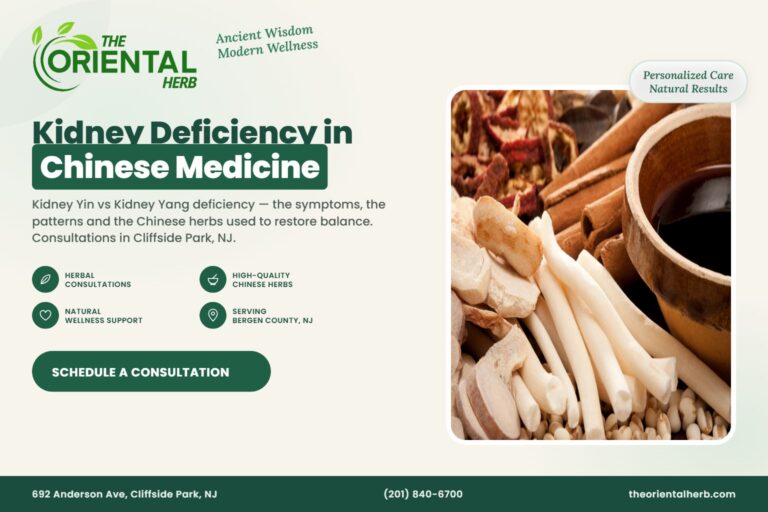
If a Chinese medicine practitioner has told you that you have “Kidney deficiency,” your first reaction was probably concern about your actual kidneys. Take a breath: in Traditional Chinese Medicine (TCM) the Kidney is a functional system, not just the organ that filters blood. It governs growth, reproduction, bones, hearing, hair, the lower back and the deep reserves of energy you draw on through life. Kidney deficiency is one of the most common patterns we see at our Cliffside Park clinic, especially in people over 40, after long illness, or after years of overwork and poor sleep.
The Kidney System in TCM
TCM says the Kidney stores Jing (essence) – the constitutional reserve you are born with and slowly spend. It also houses the root of Yin and Yang for the whole body. When the Kidney is strong, you have a steady back, good hearing, thick hair, sound sleep and reliable energy. When it weakens, those functions fade. Importantly, Kidney deficiency comes in two main forms that need opposite treatment.
Kidney Yin Deficiency
Yin is the cooling, moistening, nourishing aspect. When it is low, the body “dries out and overheats.” Typical signs:
- Night sweats and heat in the palms, soles and chest in the evening
- Dry mouth and throat, especially at night
- Dizziness, tinnitus (ringing in the ears)
- Low back soreness, weak knees
- Restless, light sleep; vivid dreams
- A red tongue with little coating; a thin, rapid pulse
Yin deficiency is common in menopause, after chronic stress, and in people who work late into the night.
Kidney Yang Deficiency
Yang is the warming, activating aspect. When it is low, the body “runs cold and slow.” Typical signs:
- Cold hands, feet and lower back; an aversion to cold
- Fatigue, low motivation, apathy
- Frequent or nighttime urination; loose stools in the early morning
- Low libido, infertility, edema in the legs
- A pale, swollen tongue; a deep, slow pulse
Many people have a mix of both, because Yin and Yang share the same root and one eventually pulls the other down.
Chinese Herbs for Kidney Yin Deficiency
- Shu Di Huang (Prepared Rehmannia) – the principal Yin and essence tonic.
- Shan Zhu Yu (Cornus) – astringes essence and supports the lower back and knees.
- Gou Qi Zi (Goji Berry) – nourishes Liver and Kidney Yin and brightens the eyes.
- Nu Zhen Zi (Ligustrum) and Han Lian Cao (Eclipta) – the Er Zhi Wan pair, gentle Yin tonics also used for premature greying.
- Zhi Mu and Huang Bai – added when deficiency heat (night sweats, hot flashes) is prominent.
The classic formula is Liu Wei Di Huang Wan (Six-Ingredient Rehmannia Pill), with variations such as Zhi Bai Di Huang Wan for heat and Qi Ju Di Huang Wan for eye symptoms.
Chinese Herbs for Kidney Yang Deficiency
- Rou Gui (Cinnamon Bark) and Fu Zi (prepared Aconite, practitioner-only) – warm the Kidney fire.
- Yin Yang Huo (Epimedium) – warms Yang and supports libido and bone strength.
- Du Zhong (Eucommia) and Xu Duan (Dipsacus) – strengthen the lower back, knees and tendons.
- Tu Si Zi (Cuscuta) – a balanced tonic used for both Yin and Yang, common in fertility formulas.
- Bu Gu Zhi (Psoralea) – for early-morning diarrhea and cold lower back.
The classic formulas are Jin Gui Shen Qi Wan (Golden Cabinet Kidney Qi Pill) and You Gui Wan.
Lifestyle That Protects the Kidney
- Sleep before 11 p.m. – TCM considers late nights the fastest way to burn Yin.
- Keep the lower back and feet warm in winter.
- Black foods (black beans, black sesame, walnuts), bone broth and seaweed are traditional Kidney foods.
- Avoid excessive caffeine and overtraining, both of which draw on Jing.
Safety Notes
Yang tonics are warming and can aggravate someone who is actually Yin deficient, causing insomnia and dryness. Rehmannia-based formulas can be heavy on weak digestion. This is why self-prescribing from a list is rarely successful – pattern diagnosis matters. If you have actual kidney disease, protein in the urine or changes in urination, see a physician; TCM support is complementary, not a substitute.
Frequently Asked Questions
Does Kidney deficiency mean my kidneys are failing?
No. It is a TCM pattern describing a cluster of symptoms; it is not a diagnosis of kidney disease. Medical kidney problems are assessed with blood and urine tests.
How long does it take to rebuild Kidney energy?
Kidney tonics work slowly. Expect three to six months of consistent herbs and lifestyle change for lasting results.
Which is more common, Yin or Yang deficiency?
Yin deficiency is more common in busy, stressed adults and in menopause; Yang deficiency is more common with age, chronic illness and in people who feel cold all the time. Many have both.
Related reading: Chinese herbs for energy and fatigue and Yin and Yang in Chinese medicine.
Talk to a Chinese herbal practitioner in Cliffside Park, NJ. The Oriental Herb has served Bergen County since 1995 with personalized herbal consultations and high-quality Chinese herbs. Book a consultation, call (201) 840-6700, or visit our Chinese herb store at 692 Anderson Ave.
This article is for educational purposes only and is not medical advice. Chinese herbs are not a replacement for diagnosis or treatment from your physician. Always tell your doctor and your herbalist about every medication and supplement you take.