
Most people view herbal supplements as natural versions of over-the-counter drugs, yet this perspective misses the profound structural intent behind traditional prescriptions. You may feel frustrated by chronic health concerns that never quite resolve or overwhelmed by the conflicting information regarding herbal safety. It’s common to feel like a mere number in a healthcare system that often prioritizes temporary relief over the person’s total well-being.
Understanding the role of herbs in Chinese medicine reveals a sophisticated system of natural healing designed to restore balance and long-term vitality. These botanical formulas don’t just target symptoms; they act as biological architects that rebuild your body’s internal community. This article explains the logic behind herbal prescriptions and highlights how new 2026 production standards ensure the safety of these ancient remedies. You’ll learn how to move beyond confusion and find a reliable mentor to guide your personal health journey.
Key Takeaways
- Learn how the role of herbs in Chinese medicine shifts the focus from temporary symptom relief to the restoration of your body’s foundational health.
- Understand how the energetic properties of herbs, including their temperature and taste, are systematically applied to rebalance specific internal organ systems.
- Discover the “Jun-Chen-Zuo-Shi” hierarchy, a traditional method of combining herbs to ensure each formula functions as a cohesive and effective healing team.
- Compare the benefits of whole-plant synergy found in traditional remedies against the isolated active compounds common in modern pharmacology.
- Identify the essential criteria for sourcing authentic herbal medicine to ensure safety and efficacy within your personal wellness journey.
The Foundational Role of Herbs in Chinese Medicine
Herbs function as the primary internal medicine branch of Traditional Chinese Medicine (TCM). While many people recognize acupuncture for its ability to regulate the body’s energetic flow through external points, herbal medicine provides the essential building blocks for internal repair. The role of herbs in Chinese medicine is to act as biological messengers that communicate directly with your organ systems to initiate a healing response. This process doesn’t simply mask a symptom; it seeks to rebuild the body’s natural capacity for self-regulation.
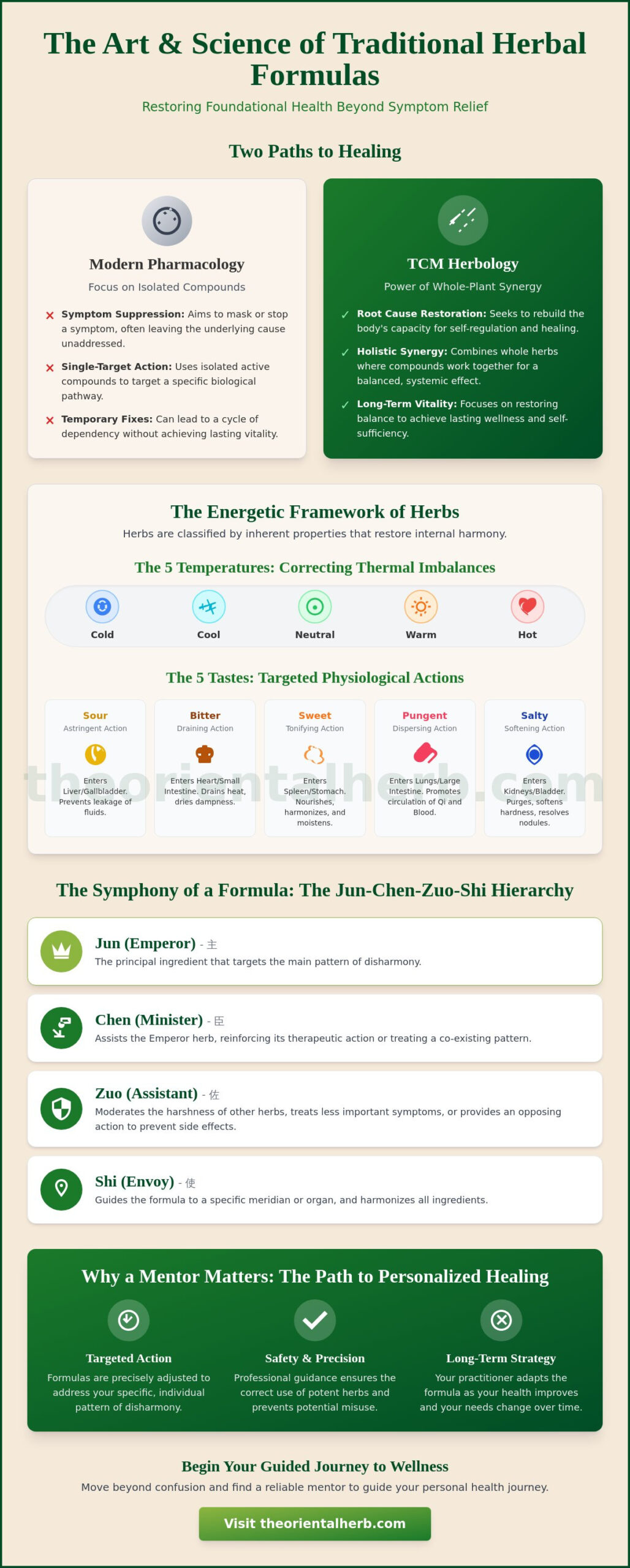
Modern healthcare often relies on symptom suppression, which can leave the underlying cause of an illness unaddressed. In contrast, TCM focuses on root cause restoration. If a patient suffers from chronic fatigue, a practitioner won’t just look for a stimulant. They’ll investigate whether the exhaustion stems from a deficiency in the digestive system or an imbalance in the kidneys. By addressing these foundational issues, the herbs help the body return to a state of self-sufficiency. This shift in perspective is vital for those who feel like they’ve been stuck in a cycle of temporary fixes without achieving lasting vitality.
A Heritage of Holistic Healing
The history of Chinese herbology spans over 2,000 years, evolving from ancient observations of the natural world into a precise clinical science. This vast pharmacopeia has transitioned from foundational texts like the Shennong Ben Cao Jing to the sophisticated clinical applications used today. Every herb is categorized by its specific properties, ensuring that prescriptions are grounded in centuries of recorded outcomes rather than guesswork. Within this tradition, the herbal role is defined as a restorer of biological harmony that aligns the body with its natural state of health.
The Practitioner as a Wise Mentor
The efficacy of any herbal treatment is inseparable from the practitioner’s diagnostic skill. A Licensed Acupuncturist serves as a mentor who interprets the subtle signals your body sends through pulse and tongue diagnosis. Because every individual possesses a unique constitution, a generic supplement from a store shelf often fails to produce results. Michael Kim at The Oriental Natural Herbs applies this deep historical wisdom to identify the specific needs of each patient. Individualized assessment remains the cornerstone of effective therapy because it ensures the formula matches the person’s internal environment. This personalized approach provides several benefits:
- Targeted Action: Formulas are adjusted to address your specific pattern of disharmony.
- Safety and Precision: Professional guidance prevents the misuse of potent herbs.
- Long-term Strategy: The practitioner adapts the role of herbs in Chinese medicine as your health improves and your needs change.
By relying on an expert’s insights, you move away from the confusion of self-prescribing and toward a structured path for recovery. This relationship transforms the healing process from a solitary struggle into a guided journey toward long-term wellness.
The Energetic Framework: How Herbs Restore Internal Harmony
Traditional Chinese Medicine classifies every botanical substance according to its inherent energetic properties rather than its chemical components alone. This classification system relies on temperature, which includes categories of Cold, Cool, Neutral, Warm, and Hot. Consequently, the role of herbs in Chinese medicine is to act as a corrective force against thermal imbalances within the body. For example, a patient presenting with signs of internal heat, such as inflammation or red skin rashes, would typically be prescribed cooling herbs to pacify that excess energy and restore a neutral state. This methodical approach ensures that the treatment addresses the environmental conditions inside the body that allowed the illness to thrive.
In addition to temperature, herbs are categorized by the Five Tastes: Sour, Bitter, Sweet, Pungent, and Salty. Each taste possesses a specific affinity for different Zang-Fu organ systems and performs a distinct physiological function. Pungent herbs often disperse stagnation and promote the circulation of Qi and Blood; meanwhile, Bitter herbs are frequently used to drain excess heat and dry dampness. This energetic framework is further refined by Meridian Entry, which describes how specific herbs are guided toward particular energetic channels. While these concepts are rooted in tradition, ongoing scientific research into Chinese medicine continues to explore how these energetic classifications correlate with modern physiological outcomes.
Balancing Yin and Yang Through Nature
The balance between Yin and Yang is fundamental to maintaining health. Yin represents the cooling, moistening, and structural aspects of the body, whereas Yang represents the warming, activating, and functional aspects. When a person experiences sluggish digestion or cold extremities, it often indicates a deficiency in Yang energy. In such cases, the role of herbs in Chinese medicine is to provide the necessary warmth to reignite metabolic function. By understanding these energetic signatures, patients can work with a professional to select herbal medicine for health issues that aligns precisely with their specific constitutional needs, ensuring that the delicate equilibrium of the organs is preserved.
The Five Elements and Seasonal Vitality
The application of herbal medicine also follows the natural cycles of the Five Elements: Wood, Fire, Earth, Metal, and Water. Each element corresponds to a specific season and organ group, requiring different herbal supports throughout the year. Specifically, cooling herbs may be utilized during the summer to protect the Heart (Fire), while tonifying herbs are often emphasized in the winter to support the Kidneys (Water). These seasonal herbal adjustments are essential for supporting long-term community health in Bergen County, as they help individuals adapt to the changing external environment. This rhythmic approach to wellness fosters a sense of resilience that lasts far beyond the resolution of a single symptom.
Comparing TCM Herbs and Modern Pharmacology: Two Paths to Healing
Modern pharmacology often focuses on isolating a single active ingredient to target a specific symptom or pathogen. This reductionist approach is highly effective for acute intervention and emergency care. Conversely, the role of herbs in Chinese medicine emphasizes the use of the entire plant, root, or mineral. By utilizing the whole substance, practitioners leverage a complex network of chemical constituents that work in concert. This natural synergy often results in a more balanced physiological effect, as secondary plant metabolites can buffer the impact of more potent compounds. This internal balancing act is a primary reason why traditional formulas are known for their ability to support the body without the harsh side effects often associated with synthetic drugs.
The two systems represent different but potentially complementary philosophies of care. While Western medicine excels at “anti-” treatments, such as antibiotics or antivirals designed to destroy a specific threat, Traditional Chinese Medicine (TCM) focuses on “pro-” treatments. These are often referred to as tonics, which are designed to nourish and strengthen the body’s defensive capabilities. Instead of simply removing a pathogen, the herbs work to cultivate an internal environment where disease cannot easily take root. This integrative perspective allows for a health plan that addresses both immediate needs and long-term vitality.
Isolated Compounds vs. Whole Plant Wisdom
TCM practitioners generally prefer the “crude” or whole herb over a lab-extracted chemical because the plant’s natural context provides inherent safety measures. For instance, a plant might contain a potent active compound alongside other elements that protect the digestive lining or support liver processing. You can explore specific Chinese medicinal herbs to understand how these diverse plant profiles contribute to a more stable and sustainable healing process. This holistic approach of Chinese herbal medicine ensures that the treatment respects the body’s complex biological systems rather than overriding them with a single, high-dose substance.
The Goal: Suppression vs. Cultivation
A common question among patients is why herbal remedies often take longer to produce noticeable results than pharmaceutical pills. A pharmaceutical drug typically forces a rapid change in the body’s chemistry to provide immediate relief, which is ideal for acute crises. However, the role of herbs in Chinese medicine is to “teach” the body to heal itself through gradual regeneration. This process of cultivation requires patience, as it involves rebuilding weakened tissues and restoring energetic balance. While a pill might suppress a cough in minutes, a well-crafted herbal formula works to strengthen the lungs and resolve the underlying dampness, leading to a recovery that is both deep and lasting.
The Art of the Formula: Why Synergy Outperforms Single Herbs
In Traditional Chinese Medicine, an herb is rarely used in isolation. Instead, practitioners craft complex formulas where multiple ingredients work together to achieve a specific therapeutic goal. The role of herbs in Chinese medicine is maximized through this synergy, which allows for a more comprehensive treatment of the patient’s condition. This approach recognizes that the human body is an intricate system; therefore, the medicine must be equally nuanced. By combining various botanical elements, a formula can address the primary illness while simultaneously supporting the body’s overall vitality. This method prevents the one-sided impact that can sometimes occur with single-ingredient supplements.
Another critical aspect of formula construction is the traditional method of processing known as Pao Zhi. This technique involves frying, steaming, or soaking herbs to alter their natural properties before they’re included in a prescription. Processing can reduce the inherent toxicity of a potent root or change the direction of an herb’s effect within the body. For instance, an herb might be processed with ginger to enhance its warming qualities or with vinegar to guide its influence toward the liver meridian. This level of refinement ensures that the role of herbs in Chinese medicine is both safe and highly targeted to the individual’s specific needs.
The Four Roles Within a Prescription
A classical prescription follows a specific hierarchy known as Jun-Chen-Zuo-Shi, which translates to Chief, Deputy, Assistant, and Envoy. The Chief (Jun) herb provides the primary force against the main pattern of disharmony. The Deputy (Chen) herbs support the Chief and treat secondary symptoms. The Assistant (Zuo) herbs perform the vital task of harmonizing the blend; they often counteract potential side effects of the more potent ingredients. Finally, the Envoy (Shi) herbs act as guides, ensuring the medicinal effects reach the correct meridian or organ system. This structure functions like a balanced health committee where every member has a specific responsibility to the patient’s well-being.
Safety and Customization in Modern Practice
Customization is what truly distinguishes traditional practice from standardized, mass-produced medicine. Two individuals might both complain of a headache, yet one may receive a formula to clear heat while the other receives one to nourish Blood. This depends entirely on the underlying root cause identified by the practitioner during the diagnostic process. This personalized approach, combined with the inherent synergy of the formula, significantly minimizes the risk of adverse reactions. As the patient heals, the practitioner modifies the prescription to reflect the body’s changing state. To achieve these results, it’s essential to use high-quality oriental herbal supplements that meet rigorous purity and sourcing standards.
If you’re ready to experience a healing plan tailored specifically to your unique constitution, consider exploring professional herbal medicine for health issues to begin your journey toward lasting vitality.
Integrating Traditional Wisdom into Your Modern Wellness Routine
Integrating traditional wisdom into a demanding modern schedule requires a fundamental shift in perspective. Rather than waiting for a health crisis to occur, you can utilize botanical formulas to maintain and protect your baseline of health. The role of herbs in Chinese medicine is particularly significant in the context of preventative care, where they function to nourish the body’s systems before significant depletion occurs. This proactive approach supports long-term vitality and addresses the natural aging process by preserving essential fluids and internal energy. As of March 1, 2026, new international regulations have strengthened the supervision of herbal production, ensuring that patients have access to remedies that meet rigorous agricultural and manufacturing standards. These updates provide an extra layer of confidence for those looking to incorporate these ancient tools into their daily lives.
Quality remains the most critical factor when choosing herbal products. While generic online stores may offer convenience, they often lack the professional oversight required to ensure purity and correct species identification. Sourcing your remedies through a reputable clinic ensures that the formulas are free from contaminants and have been processed according to traditional standards. This distinction is vital because the efficacy of a formula depends on the integrity of its individual components. By prioritizing professional-grade sourcing, you ensure that the medicinal properties of the plants are preserved and that the treatment remains safe for long-term use.
Finding Your Path to Balance
Recognizing when your body is out of balance is the first step toward lasting restoration. Subtle signals such as persistent fatigue, irregular digestion, or disrupted sleep patterns often indicate that your internal systems are struggling to maintain equilibrium. When you begin your journey, the first step is an herbal consultation with a Licensed Acupuncturist. This process involves a thorough assessment of your lifestyle, physical symptoms, and energetic markers. This diagnostic depth allows the practitioner to craft a strategy that respects your unique constitution. It’s helpful to view health as a continuous process of cultivation; the role of herbs in Chinese medicine is to provide the steady support needed for your body to bloom into its healthiest state.
Your Local Resource for Natural Health
For residents of Cliffside Park and the broader Bergen County area, having a reliable mentor nearby is essential for a successful health journey. Michael Kim at The Oriental Natural Herbs remains dedicated to providing high-quality herbal medicine that honors traditional principles while meeting modern safety expectations. This local presence allows for a personalized level of care that generic health apps or distant retailers cannot provide. By choosing a dedicated provider, you gain a partner who understands your health history and can adjust your care as your vitality improves. We invite you to visit our clinic and discover how the wisdom of the Orient can be seamlessly integrated into your modern lifestyle to foster a future of sustained health and community vitality.
Empower Your Health Through Time-Tested Wisdom
The role of herbs in Chinese medicine extends far beyond simple symptom management; it offers a comprehensive pathway to internal harmony and structural resilience. By utilizing the synergistic power of classical formulas instead of isolated compounds, you allow your body to engage in a deeper, more sustainable process of self-repair. This ancient practice provides the clarity needed to address chronic concerns that modern systems often overlook. It’s a journey of cultivation that prioritizes your long-term vitality over temporary relief.
Choosing the right partner is essential for navigating this traditional path safely and effectively. Michael Kim is a Licensed Acupuncturist and Diplomate of Oriental Medicine who has been serving the Bergen County community since 1995. He provides high-quality, practitioner-vetted herbal formulas designed to meet your specific constitutional needs. Begin your journey to natural balance with Michael Kim at The Oriental Natural Herbs and reclaim your sense of well-being. True health is within your reach, and the right guidance can make all the difference in your quest for lasting vitality.
Frequently Asked Questions
What is the primary role of herbs in Chinese medicine?
The primary role of herbs in Chinese medicine is to act as biological architects that restore internal balance and address the root cause of disharmony. Unlike treatments that merely mask symptoms, these botanical substances nourish the body’s systems and regulate the flow of Qi and Blood. This process helps the body return to its natural state of vitality by correcting thermal and energetic imbalances that have allowed illness to persist.
Are Chinese medicinal herbs safe to take with Western medications?
Safety depends on the specific interactions between the herbs and any pharmaceuticals you’re currently taking. While many traditional remedies are safe, some can alter the metabolism of Western drugs. It’s vital to consult with a qualified professional who can evaluate your health history and ensure that your integrated treatment plan is both safe and effective. Professional guidance prevents adverse reactions and ensures that both systems work in harmony.
How long does it take for Chinese herbs to show results?
The timeline for results varies depending on whether the condition is acute or chronic. Acute issues, such as a sudden cold, might show improvement within a few days of starting a formula. However, chronic conditions that have developed over several years often require a longer course of treatment, typically ranging from a few weeks to several months. This steady approach ensures that the body’s foundational health is properly rebuilt for lasting vitality.
Why are Chinese herbs usually prescribed as a formula rather than single pills?
Herbs are prescribed as formulas to leverage the power of synergy and minimize potential side effects. A single herb might have a potent effect but could cause an imbalance if used alone. In a formula, the “Assistant” and “Envoy” herbs harmonize the blend and guide the “Chief” herb to the correct organ system. This creates a balanced health committee that treats the whole person rather than an isolated symptom.
Can Chinese herbs help with chronic conditions like acid reflux or skin issues?
Yes, traditional formulas are frequently used to manage chronic conditions like acid reflux and persistent skin issues. Instead of just suppressing inflammation or acidity, the herbs address the underlying patterns of disharmony, such as damp-heat or stomach fire. By correcting these internal environments, the body can resolve the symptoms naturally and maintain long-term digestive and dermatological health without relying on temporary suppressive measures.
How do I know if the Chinese herbs I buy online are high quality?
High-quality herbs are typically sourced through professional clinics rather than generic online retailers. You should look for products that comply with the Special Provisions for Supervision and Administration of Traditional Chinese Medicine Production, which took effect on March 1, 2026. These regulations ensure that herbs are produced under strict Good Agricultural Practice standards, providing verification of purity and potency that most mass-market supplements lack today.
What is the difference between an herbal supplement and a TCM formula?
An herbal supplement is often a standardized, single-ingredient product sold for a general health benefit. Conversely, a TCM formula is a complex blend of multiple herbs tailored to an individual’s specific diagnostic pattern. The role of herbs in Chinese medicine is much more targeted in a formula, as the ingredients are selected to work together to address your unique internal state and constitutional requirements.
Do I need to see an acupuncturist to get a Chinese herbal prescription?
While some herbs are available over the counter, seeing a Licensed Acupuncturist or a qualified herbalist is essential for an effective prescription. These professionals use diagnostic tools like pulse and tongue analysis to identify your specific needs. This individualized assessment ensures that you receive a formula that matches your constitution, preventing the risks and lack of results associated with self-prescribing potent botanical substances.