
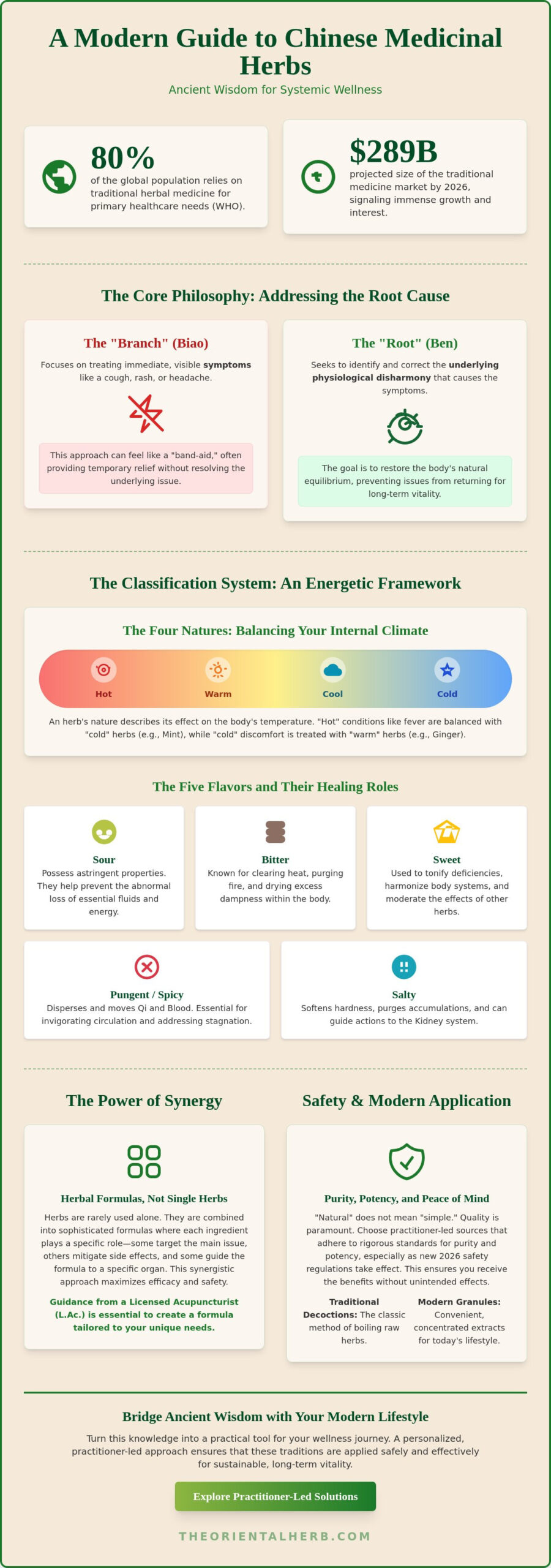
Did you know that nearly 80% of the global population relies on traditional herbal medicine for their primary healthcare needs according to the World Health Organization? Even with the traditional medicine market reaching 289.08 billion dollars in 2026, it’s common to feel overwhelmed by the vast array of chinese medicinal herbs currently available. You’ve likely experienced the frustration of “band-aid” solutions that ignore systemic health, or felt anxious about the quality of supplements ordered online. It’s time to move beyond the confusion and toward a grounded, professional understanding of botanical health.
This guide explains how these ancient remedies function as a synergistic system to restore balance and long-term vitality. We’ll provide a clear framework for categorizing herbs and help you gain confidence in choosing practitioner-led sources, especially as new 2026 safety regulations take effect in China and Europe. You’ll discover actionable steps to integrate these traditions into your daily routine, turning ancient wisdom into a practical tool for modern wellness.
Key Takeaways
- Understand the fundamental shift from treating isolated symptoms to addressing the root cause of disharmony through a 2,500 year old botanical system.
- Learn how chinese medicinal herbs are meticulously classified by their thermal nature and flavor profile to target specific organ systems and restore physiological balance.
- Discover the primary functional categories of herbs and how practitioners use them to create synergistic formulas tailored to your unique health pattern.
- Gain clarity on the safety, purity, and efficacy of different herbal preparations, including traditional decoctions and modern concentrated granules.
- Explore how a personalized, practitioner led approach can bridge ancient wisdom with your modern lifestyle for sustainable, long term vitality.
Understanding the Framework of Chinese Medicinal Herbs
The sophisticated application of chinese medicinal herbs represents one of the world’s oldest continuously practiced medical traditions. This botanical system includes thousands of substances that have been cataloged and refined for over 2,500 years. Unlike modern pharmaceuticals that often isolate a single active compound, this tradition views plants as complex entities that interact with the human body in multifaceted ways. This perspective transforms herbalism from a simple remedy into a comprehensive strategy for long-term health.
Central to this practice is the distinction between the “root” (Ben) and the “branch” (Biao). Most western approaches focus on the branch, which refers to the immediate symptoms like a cough or a headache. In contrast, practitioners of this ancient wisdom look for the root cause, the underlying physiological disharmony that allowed the symptom to manifest. By addressing the root, the goal is not merely to suppress discomfort but to restore a state of equilibrium that prevents the issue from returning.
Success in this field relies heavily on the principle of synergy. Herbs are rarely prescribed in isolation; instead, they’re combined into sophisticated formulas where each ingredient serves a specific purpose. Some herbs target the primary issue while others mitigate side effects or guide the formula to specific organ systems. Because of this complexity, the guidance of a Licensed Acupuncturist (L.Ac.) is essential. These professionals possess the training to diagnose your unique internal “pattern” and select the precise herbal combinations your body requires. Understanding the role of herbs in Chinese medicine reveals how these botanical formulas act as biological architects that rebuild your body’s internal balance rather than simply masking symptoms.
The Ancient Roots of Modern Herbalism
The foundation of this practice rests on historical texts like the Shen Nong Ben Cao Jing, a classic work that first categorized botanicals by their medicinal properties. This Chinese herbology framework continues to evolve as modern botanical science in 2026 provides new layers of validation for these traditional uses. The Materia Medica remains the definitive catalog of Chinese herbs, serving as a living record of human experience and clinical observation.
Why ‘Natural’ Does Not Mean ‘Simple’
Many people approach health with a “one-pill-for-one-ill” mindset, but holistic care requires a more nuanced view. Natural substances are potent and require careful handling to ensure they support the body without causing unintended imbalances. The Oriental Natural Herbs maintains a strict commitment to quality, ensuring that every botanical meets rigorous standards for purity and potency. You can’t achieve systemic wellness through guesswork. True vitality requires a professional framework where the application of chinese medicinal herbs is handled with the clinical precision it deserves.
The Classification System: How Herbs are Evaluated
The classification of chinese medicinal herbs is far more complex than simple nutritional labeling. Each botanical is evaluated through a rigorous energetic lens that has been refined over centuries. This system allows practitioners to select herbs that precisely match a patient’s internal state. By understanding these properties, we move away from seeing herbs as generic supplements and begin to see them as targeted therapeutic tools. It’s a method that ensures every formula is as unique as the individual receiving it.
The Four Natures: Balancing Your Internal Climate
A primary consideration is the “nature” or temperature of the herb. This isn’t about physical heat but the effect the herb has on your body’s internal climate. If you suffer from a “hot” condition like acute inflammation or a fever, a practitioner will select “cold” or “cool” herbs to restore balance. Using the wrong temperature can be counterproductive. For instance, Mint is considered cool and is often used for heat related issues; Ginger is warm and ideal for cold induced discomfort. Matching the herb’s nature to your constitution is the first step in successful therapy.
The Five Flavors and Their Healing Roles
- Sour: These herbs have astringent properties. They help prevent the loss of essential fluids and energy.
- Bitter: These are known for clearing heat and drying excess dampness within the body.
- Sweet: Practitioners use these to tonify and harmonize the digestive system. They provide a foundation for energy production.
- Pungent/Spicy: These move Qi and promote circulation. They’re vital for addressing stagnation.
- Salty: These help in softening hardness and purging accumulation.
Beyond flavor and nature, herbs are also categorized by their Meridian Entry and Direction. Meridian Entry describes which specific energetic pathways the herb targets. This ensures the medicine reaches the intended organ system, such as the Liver or Spleen. The “Direction” of an herb refers to whether its energy moves upward, downward, outward, or inward. This level of precision is why professional oversight is so critical. Research into Traditional Chinese Medicine safety and effectiveness emphasizes that these properties must be balanced correctly to achieve the desired outcome. If you’re looking for a personalized strategy, you can explore the options for herbal medicine for health issues tailored to your specific needs. This meticulous evaluation ensures that chinese medicinal herbs work in harmony with your unique constitution rather than against it.
Core Categories of Chinese Medicinal Herbs by Function
In traditional practice, chinese medicinal herbs aren’t viewed as individual treatments for specific symptoms. Instead, they’re organized into sophisticated functional categories based on how they influence the body’s internal environment. A practitioner determines which category is appropriate by identifying a “pattern” of disharmony through a comprehensive assessment. This method ensures that the herbs chosen address the systemic state of the individual rather than offering a temporary fix. For a deeper look into how these systems interact, you can read more in our guide on Exploring Herbal Medicine: A Comprehensive Guide to Natural Healing Systems.
Most effective prescriptions rely on a combination of herbs from multiple categories to achieve a balanced result. This synergy allows one herb to enhance the strengths of another while neutralizing potential harshness. It’s a delicate process of formulation that requires years of clinical study. Because these interactions are complex, seeking expert advice on Chinese herbs is vital for anyone looking to incorporate these botanicals safely into their health regimen. A professional diagnosis ensures the formula matches your specific physiological needs.
Tonifying Herbs: Building Vitality and Essence
Tonifying herbs are used when there’s a deficiency in the body’s fundamental substances. Qi Tonics, such as Ginseng (Ren Shen) and Astragalus (Huang Qi), are frequently utilized to address chronic fatigue and support the immune system. When the body lacks nourishment, Blood Tonics like Angelica Sinensis (Dang Gui) are often prescribed, particularly to support women’s health. Yin Tonics, including the Goji Berry (Gou Qi Zi), serve to cool and moisturize the body when internal dryness occurs. Finally, Yang Tonics help strengthen the body’s metabolic “fire,” providing essential support for kidney health and overall warmth.
Clearing and Moving Herbs: Addressing Stagnation
When the body experiences excess or blockage, practitioners turn to herbs that clear or move energy. Heat-Clearing herbs, such as Honeysuckle (Jin Yin Hua), are essential for detoxification and managing internal inflammation. If the physical toll of stress and emotional tension causes a sense of being “stuck,” Qi-Regulating herbs are introduced to restore smooth flow. Similarly, Blood-Invigorating herbs are used to promote healthy circulation and address localized pain. These categories demonstrate the versatility of chinese medicinal herbs in transforming stagnation into active vitality and helping the body return to its natural, fluid state.
Integrating Chinese Herbs into a Modern Lifestyle Safely
Adopting a botanical regimen requires more than just curiosity; it demands a commitment to safety and professional oversight. Many people hesitate to use chinese medicinal herbs due to concerns regarding purity or potential interactions with conventional medications. These anxieties are valid, but they’re easily addressed through a practitioner led approach. A professional herbalist performs a comprehensive herb drug interaction check, ensuring that your natural supplements complement rather than conflict with your existing healthcare plan. This clinical scrutiny is what transforms a simple supplement into a reliable therapeutic tool.
The choice between traditional decoctions and modern granules is another vital consideration for the modern seeker. While a decoction involves boiling raw herbs into a potent tea, modern granules and capsules offer a convenient alternative for those with busy schedules. Both methods are effective when sourced correctly. As of March 1, 2026, new regulations in China have strengthened the supervision of decoction pieces and formula granules, providing an additional layer of global quality assurance. This shift reflects a growing international commitment to standardized herbal care, making it easier for patients to trust the substances they’re consuming. To understand how these evolving production standards align with the role of herbs in Chinese medicine as a structured healing system, exploring the logic behind traditional prescriptions can help you make more informed choices.
Quality Control and Sourcing in 2026
Professional grade medicinal herbs are distinct from the generic options found in common grocery stores. The difference lies in the rigorous testing for heavy metals, pesticides, and microbial contaminants. Good Manufacturing Practice (GMP) standards are a set of requirements that ensure products are consistently produced and controlled according to strict quality benchmarks. The Oriental Natural Herbs prioritizes these standards, ensuring that every batch of chinese medicinal herbs undergoes stringent laboratory testing. This dedication to purity protects the community and ensures that the historical wisdom of the herbs isn’t compromised by modern pollutants.
Finding a Trusted Chinese Herb Store in New Jersey
For residents in Bergen and Union County, local proximity to expert care is a significant advantage. Finding a trusted source near Cliffside Park, Fort Lee, or Teaneck allows for ongoing consultations that adapt to your changing health needs. The value of working with a Licensed Acupuncturist (L.Ac.) and a Diplomate of Oriental Medicine cannot be overstated; these credentials signify a deep mastery of the Materia Medica. Once you receive your herbs, maintain their potency by storing them in a cool, dark place away from direct sunlight and moisture. If you’re ready to begin your journey with professional guidance, you can access high quality herbal medicine for health issues through a dedicated local provider who understands your unique constitution.
The Oriental Natural Herbs: Your Bridge to Holistic Health
Michael Kim has spent over 30 years serving the Bergen County community, providing a stable foundation for those seeking to incorporate chinese medicinal herbs into their lives. His approach is rooted in the belief that true healing requires more than a standard product; it requires a formula tailored to your unique pattern of disharmony. By moving beyond generic supplements, you can access a level of care that respects the complexity of your body’s systems. This personalized methodology ensures that every herbal recommendation serves a specific, restorative purpose.
Our mission is centered on empowering the public through natural, time tested remedies that have been validated by centuries of clinical use. We act as a bridge, connecting ancient botanical wisdom with the practical needs of modern individuals. For those who are ready to take the next step in their wellness journey, our Oriental Herbal Supplements: A 2026 Buyer’s Guide to Natural Wellness provides a structured resource for understanding product selection. By focusing on education and transparency, we help you transition from feeling overwhelmed to feeling confident in your health choices.
Customized Herbal Solutions for Modern Ailments
Modern life often presents systemic challenges such as chronic stress, digestive irregularities, and weakened immune responses. We address these issues through specialized herbal medicine for health issues, creating formulas that work synergistically to restore your body’s natural state of balance. Our retail location provides convenient access for residents in Ridgefield, North Bergen, and Englewood, making it easy to maintain a consistent wellness routine. Beginning your path toward better health starts with a professional herbal assessment where we can identify the root causes of your discomfort. This structured evaluation is the key to moving beyond “band-aid” solutions and achieving sustainable vitality.
Commitment to the New Jersey Community
Since 1995, The Oriental Natural Herbs has stood as a reliable resource for natural healing across Union and Bergen counties. We believe that a supportive, mentor like relationship is essential for making informed decisions about your lifestyle. This dedication to community health is not just a business model; it’s a long term commitment to the public’s collective vitality. We take pride in being a stable presence for families and individuals who value natural, professional grade care. We invite you to experience the difference that a knowledgeable, professional partner can make in your health journey. Contact The Oriental Natural Herbs for a professional consultation to discover how chinese medicinal herbs can be integrated into your life for lasting wellness.
Embracing a Balanced Future with Herbal Wisdom
The journey toward systemic wellness begins with shifting from temporary fixes to a holistic understanding of your body’s internal climate. You’ve seen how the sophisticated classification of chinese medicinal herbs allows for a precise, personalized approach to health that targets the root cause of disharmony rather than just the symptoms. By integrating these time-tested functional categories with modern safety standards, you can move toward a life of sustained vitality and balance.
Since 1995, The Oriental Natural Herbs has served as a dedicated resource for the Bergen and Union County communities. Led by Michael Kim, a Licensed Acupuncturist and Diplomate of Oriental Medicine with over 30 years of experience, we’re committed to helping you navigate your health journey with professional clinical expertise. It’s time to stop feeling overwhelmed by your options and start building a foundation for long-term wellness. Schedule a consultation with our Licensed Acupuncturist today to begin your personalized herbal medicine plan. Your path to restorative harmony is well within reach.
Frequently Asked Questions
Are Chinese medicinal herbs safe to take with prescription medications?
Safety depends entirely on the specific combination of botanicals and pharmaceuticals you’re using. While many herbs are safe when managed by a professional, certain combinations can cause adverse interactions or alter the efficacy of your medicine. It’s essential to disclose all current medications to your practitioner before starting a regimen. They’ll verify that the chinese medicinal herbs you’re considering don’t interfere with the metabolism of your pharmaceutical prescriptions. This clinical oversight ensures your integrative health plan remains both safe and effective.
How long does it typically take to see results from Chinese herbal medicine?
The timeframe for improvement depends largely on whether your condition is acute or chronic. Acute issues like a common cold might show changes within 24 to 48 hours of consistent use. Chronic systemic imbalances generally require a longer commitment, often spanning several weeks or months. Consistency is vital because the herbs work by gradually shifting your internal environment back to a state of equilibrium. They focus on long-term restoration rather than providing an immediate, temporary suppression of symptoms.
Do I need a prescription to buy Chinese medicinal herbs?
You don’t need a medical prescription to purchase these herbs in the United States because the FDA classifies them as dietary supplements. While they’re accessible to the public, taking them without professional guidance isn’t recommended. A Licensed Acupuncturist has the clinical training to identify your specific pattern of disharmony. This ensures you’re using the correct botanicals for your unique constitution instead of relying on generic products that might not be appropriate for your health needs.
What is the difference between a single herb and an herbal formula?
A single herb focuses on one primary therapeutic property, whereas a formula is a complex combination of multiple ingredients. Practitioners rarely use herbs in isolation because formulas are designed to be synergistic. This means they include “chief” herbs to address the main issue and “assistant” herbs to enhance results or neutralize potential side effects. This balanced approach provides a more comprehensive treatment that addresses the root cause and the symptoms simultaneously through botanical harmony.
How do I know if the Chinese herbs I buy online are authentic and pure?
Authenticity and purity are best verified through Good Manufacturing Practice (GMP) certification and transparent third-party laboratory testing. You should prioritize sources that provide documentation of testing for heavy metals, pesticides, and microbial contaminants. Many online marketplaces lack these stringent quality controls. Choosing a practitioner-led source ensures that the chinese medicinal herbs you receive have been vetted for clinical potency. This protects you from contaminated or counterfeit products that may be found on unregulated platforms.
Can Chinese medicinal herbs help with chronic stress and anxiety?
These botanicals are frequently used to manage the physical and emotional impact of chronic tension. In traditional practice, stress is often viewed as a stagnation of Qi or an imbalance in the heart and liver systems. Specific herbs are categorized for their ability to soothe the nervous system and promote a smooth flow of internal energy. By addressing the physiological roots of emotional tension, herbal therapy helps restore a sense of calm and resilience in your daily life.
What are the most common side effects of Chinese herbal remedies?
Most side effects are mild and typically involve temporary digestive changes like bloating, gas, or a change in bowel movements. These reactions often occur when a formula is slightly too rich or cooling for your current digestive strength. If you experience discomfort, it’s a sign that your practitioner needs to adjust the dosage or the specific herbal combination. Professional monitoring ensures that your body adapts comfortably to the treatment as your internal balance begins to shift and stabilize.
Is Chinese herbal medicine suitable for children and the elderly?
Herbal medicine is appropriate for all ages, but the approach must be highly specialized for children and the elderly. Pediatric care often uses lower dosages and gentler delivery methods like powders or glycerite tinctures. For the elderly, practitioners focus on supporting the body’s foundational essence while carefully screening for interactions with existing medications. In both cases, a professional assessment is mandatory to ensure the treatment is gentle and appropriate for their specific stage of life.