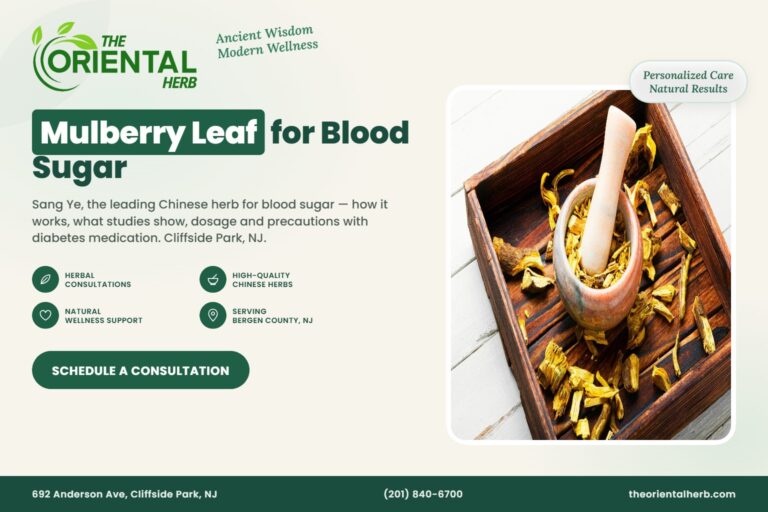
Of all the Chinese herbs discussed for blood sugar, mulberry leaf – Sang Ye – is the one with the most straightforward story. It has been used in Chinese medicine for two thousand years, it is gentle enough to drink as a daily tea, and in the last twenty years it has attracted serious research for its effect on blood sugar after meals. This profile covers what it does, how to use it, and the precautions that matter if you take diabetes medication. For how it fits a full plan, see Chinese herbs for diabetes and blood sugar support.
Mulberry Leaf in Traditional Use
Sang Ye is classified as a cool, sweet-bitter herb that clears heat from the Lung and Liver, benefits the eyes and – in the diabetic context – relieves the “wasting-thirst” pattern of dry mouth, frequent urination and fatigue. It appears in Sang Ju Yin for colds and in many modern formulas for blood sugar.
How It Works
Mulberry leaf contains 1-deoxynojirimycin (DNJ), which inhibits alpha-glucosidase – the enzyme that breaks carbohydrates into glucose in the gut. Less glucose is released quickly, so the post-meal spike is smaller. This is the same mechanism as the prescription drug acarbose, in a milder form. The leaf also contains flavonoids and fiber with antioxidant effects.
What the Research Shows
Several small clinical trials have found that mulberry leaf extract taken with a carbohydrate meal reduces the rise in blood sugar afterwards in both healthy people and people with type 2 diabetes. Longer trials show modest improvements in fasting glucose and HbA1c in some groups. The effect is real but moderate – a useful addition to diet and medication, not a substitute.
How to Take It
- Tea: 3–5 g dried leaf steeped 10 minutes, with or just before meals, one to three times daily.
- Granules or extract: as directed by your practitioner; standardized extracts are dosed by DNJ content.
- In formulas: combined with Astragalus, Chinese yam, ginseng or Rehmannia depending on the pattern.
Safety and Interactions
- With insulin or sulfonylureas, mulberry leaf can add to the blood-sugar-lowering effect – monitor and inform your doctor.
- Mild bloating or loose stools can occur at first, as with acarbose.
- Not studied in pregnancy; avoid unless advised.
- Choose a reputable source; leaf quality varies widely.
Frequently Asked Questions
Does mulberry leaf lower A1C?
Some trials show small reductions over 8–12 weeks when taken consistently with meals; results vary between people.
Is mulberry leaf the same as mulberry fruit?
No. The fruit (Sang Shen) is a Blood and Yin tonic; the leaf is the blood-sugar herb.
Where can I get good-quality mulberry leaf in New Jersey?
Our Chinese herb store in Cliffside Park stocks tea-grade leaf and granules; see also our guide to Chinese herbal teas for blood sugar.
Talk to a Chinese herbal practitioner in Cliffside Park, NJ. The Oriental Herb has served Bergen County since 1995 with personalized herbal consultations and high-quality Chinese herbs. Book a consultation, call (201) 840-6700, or visit our Chinese herb store at 692 Anderson Ave.
This article is for educational purposes only and is not medical advice. Chinese herbs are not a replacement for diagnosis or treatment from your physician. Always tell your doctor and your herbalist about every medication and supplement you take.