
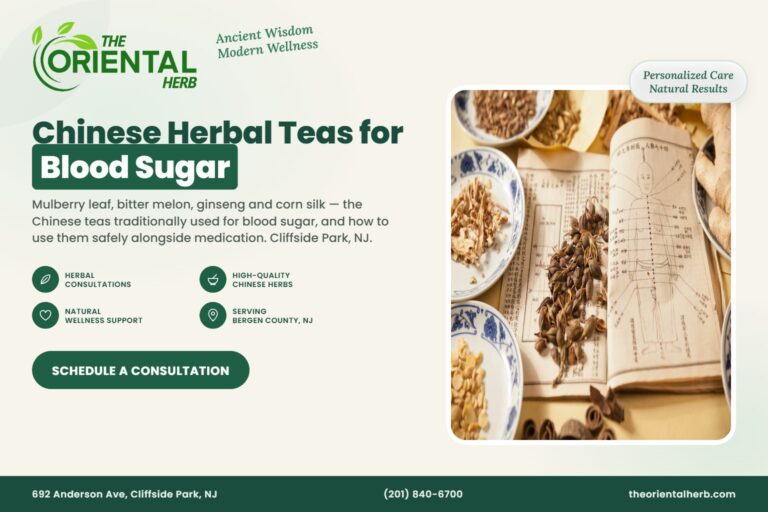
People managing type 2 diabetes or prediabetes often ask whether there is a tea they can drink daily that helps. There are several in the Chinese tradition – mulberry leaf above all – and some have reasonable research behind them. Two rules first: these teas support medication and diet, they never replace them; and if you are on insulin or sulfonylureas, your doctor needs to know, because the combination can lower blood sugar further than intended. For the full approach, see Chinese herbs for diabetes and blood sugar support.
Teas Traditionally Used for Blood Sugar
Sang Ye (Mulberry Leaf) Tea
The leading TCM tea for blood sugar. Mulberry leaf contains DNJ, a compound studied for slowing carbohydrate absorption after meals. Drink a cup with or just before carbohydrate-heavy meals.
Ku Gua (Bitter Melon) Tea
Very bitter, cooling, and one of the most-studied traditional foods for blood sugar. Sliced and dried bitter melon is brewed as tea; some people prefer it cooked as a vegetable.
Ren Shen or Xi Yang Shen (Asian or American Ginseng) Tea
Ginseng has been studied for post-meal glucose and for the fatigue and thirst of the Qi-and-Yin-deficient diabetic pattern. American ginseng is cooler and often better tolerated.
Yu Mi Xu (Corn Silk) Tea
Gentle, diuretic and traditionally used in China for diabetes with frequent urination and swelling.
Huang Qi (Astragalus) and Shan Yao (Chinese Yam) Decoction
A tonic pairing for the tired, weak diabetic with poor digestion; simmered rather than steeped.
Ge Gen (Kudzu Root) Tea
Used for thirst and the neck stiffness and circulation issues that accompany diabetes.
How to Use Them
- Mulberry leaf with meals; ginseng in the morning; corn silk and bitter melon between meals.
- Check blood sugar more often for the first two weeks of any new tea.
- No sugar, honey or sweetened creamers – obvious, but often forgotten.
- One tea at a time, so you know what is doing what.
Safety – Please Read
- Hypoglycemia risk: with insulin, glipizide, glimepiride or glyburide, these teas can push sugar too low. Agree a plan with your doctor.
- Ginseng interacts with warfarin and some antidepressants.
- Bitter melon is avoided in pregnancy.
- Keep taking prescribed medication; herbs are support.
Frequently Asked Questions
Which Chinese tea lowers blood sugar the most?
Mulberry leaf has the clearest effect on post-meal spikes; bitter melon and ginseng have supporting evidence. None replaces metformin.
Can I drink mulberry leaf tea every day?
Yes for most people, one to three cups with meals. Monitor your readings and tell your doctor.
Does the same tea help cholesterol?
Hawthorn and pu-erh are the cholesterol teas; see Chinese herbs for cholesterol. For weight, see Chinese herbal teas for weight loss.
Talk to a Chinese herbal practitioner in Cliffside Park, NJ. The Oriental Herb has served Bergen County since 1995 with personalized herbal consultations and high-quality Chinese herbs. Book a consultation, call (201) 840-6700, or visit our Chinese herb store at 692 Anderson Ave.
This article is for educational purposes only and is not medical advice. Chinese herbs are not a replacement for diagnosis or treatment from your physician. Always tell your doctor and your herbalist about every medication and supplement you take.