
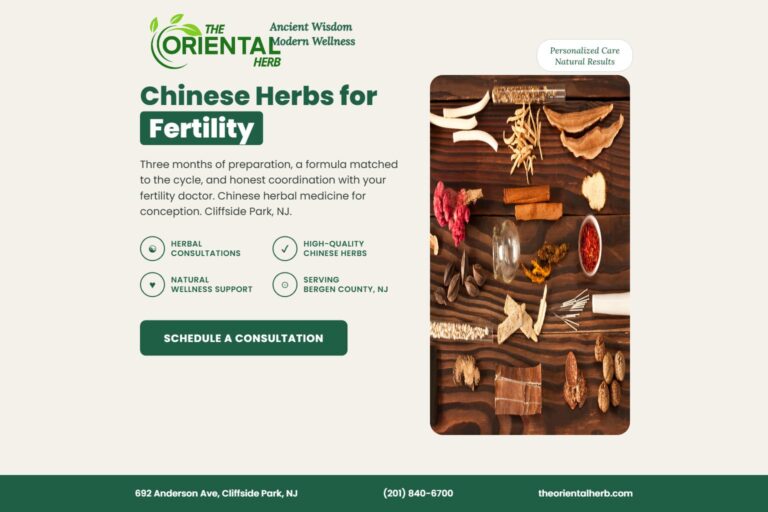
Fertility is one of the oldest specialties in Chinese medicine, and one of the areas where it has most to offer alongside modern care. The approach is not a “fertility herb”. It is three months of preparation – the time it takes an egg to mature and sperm to form – during which a formula is adjusted to the phase of the cycle and the person’s pattern. This guide explains how Chinese herbs for fertility are used, for whom, and how we work with reproductive endocrinologists rather than around them.
The patterns we see most
- Kidney deficiency – the foundation of fertility in TCM. Long or irregular cycles, scanty periods, low libido, low back ache, feeling cold (Yang type) or hot at night (Yin type), often in women over 35 or after years of stress. Herbs: Shu Di Huang, Tu Si Zi (Cuscuta), Gou Qi Zi (Goji), Du Zhong, Rou Cong Rong. Read our post on Kidney deficiency.
- Blood deficiency – light periods, pale face, dizziness, dry skin, poor sleep; the lining is thin. Herbs: Dang Gui, Bai Shao, Shu Di Huang, E Jiao. See Blood deficiency and Dang Gui.
- Liver Qi stagnation – PMS, breast tenderness, clotted painful periods, stress-driven irregularity. Herbs: Chai Hu, Xiang Fu, Bai Shao. Formula: Xiao Yao San. See menstrual cramps and PMS.
- Phlegm-dampness – the PCOS picture: long cycles, weight gain, acne, excess hair. Herbs: Cang Zhu, Ban Xia, Chen Pi, Shan Zha. See our post on Chinese herbs for PCOS.
Cycle-phase prescribing
A fertility formula changes through the month: after the period, Blood- and Yin-nourishing herbs to build the lining and the egg; around ovulation, gently moving herbs to help release; after ovulation, warming, Yang-supporting herbs to hold the luteal phase; and during the period, herbs to move Blood and clear completely. Basal temperature charts make this precise – we ask clients to keep one.
Men matter too
Half of fertility difficulty involves a male factor, and Chinese herbs for sperm count, motility and morphology have been used for centuries – Gou Qi Zi, Tu Si Zi, Wu Wei Zi, Huang Jing, Ren Shen. Three months of herbs, no alcohol or hot baths, and a semen analysis before and after. We treat couples as a pair whenever possible.
Working with IVF and fertility medication
We are clear about this: herbs are stopped or changed during stimulation and transfer unless your fertility clinic agrees to them, because some herbs affect hormones and clotting. The best use of herbs with IVF is in the three months before a cycle, when egg and sperm quality can still be influenced, and between cycles. Bring your protocol and we will write the formula around it.
Honest expectations
Herbs improve the conditions for conception; they do not guarantee it. Age, tubal factors, severe male factor and some structural problems need medical treatment, and we will say so. Most couples we see commit to three to six months. Many conceive naturally in that window; others go into IVF in better shape.
FAQ
Should I stop herbs once pregnant?
Most fertility formulas are stopped at a positive test and replaced, if needed, with a conservative pregnancy-safe formula agreed with your doctor. Never continue a fertility formula unsupervised.
Do Chinese herbs for fertility interact with Clomid or letrozole?
They can. Tell us the drug and the days you take it; we schedule herbs around it or pause them.
How much does it cost?
Far less than one IVF cycle. Call for consultation and formula pricing.
Talk to a Chinese herbal practitioner in Cliffside Park, NJ. The Oriental Herb has served Bergen County since 1995 with personalized herbal consultations and high-quality Chinese herbs. Book a consultation, call (201) 840-6700, or visit our Chinese herb store at 692 Anderson Ave.
This article is for educational purposes only and is not medical advice. Chinese herbs are not a replacement for diagnosis or treatment from your physician. Always tell your doctor and your herbalist about every medication and supplement you take.