
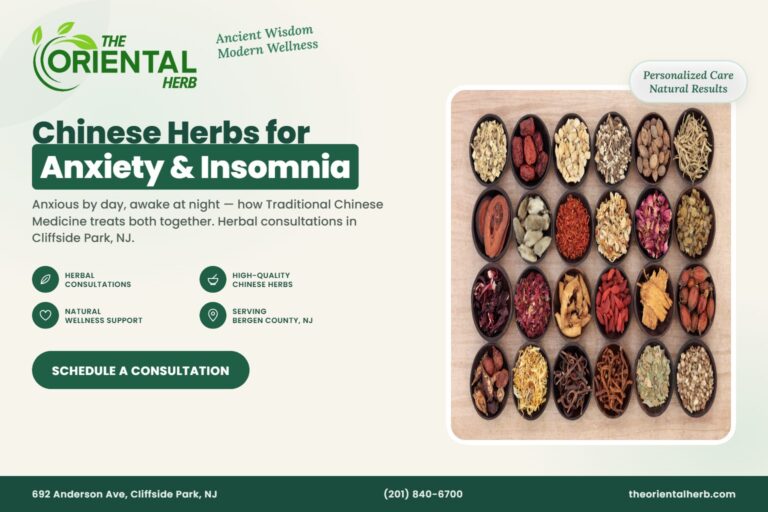
Anxiety and insomnia feed each other: the anxious mind will not switch off at night, and the exhausted body is more anxious the next day. Treating them as two separate problems rarely works. Traditional Chinese Medicine (TCM) treats them as one pattern, and Chinese herbs for anxiety and insomnia are among the most prescribed formulas in our Cliffside Park clinic. This guide explains the patterns and the herbs; our main pages on herbal remedies for anxiety and Chinese herbs for sleep go deeper on each.
Why Anxiety and Insomnia Come Together
In TCM the mind (Shen) rests in the Heart at night, anchored by Heart Blood and Yin. Anything that depletes Blood and Yin – overwork, worry, blood loss, menopause – leaves the mind unanchored: anxious by day, restless by night. Anything that generates heat – stress, anger, alcohol, late nights – agitates the mind further. The common patterns:
- Heart and Spleen deficiency – worry, overthinking, fatigue, poor appetite, difficulty falling asleep, light sleep. The classic “tired but wired.”
- Heart Yin deficiency with heat – palpitations, night sweats, vivid dreams, waking between 1 and 3 a.m.
- Liver Qi stagnation turning to fire – irritability, tension, headaches, waking angry or anxious.
- Gallbladder deficiency with phlegm – timidity, being easily startled, nausea, dreams of falling.
Chinese Herbs for Anxiety and Insomnia
Suan Zao Ren (Sour Jujube Seed)
Nourishes Heart and Liver Blood and is the lead herb in Suan Zao Ren Tang, the foundational formula for insomnia with anxiety and exhaustion.
Bai Zi Ren (Biota Seed) and Yuan Zhi (Polygala)
Calm the spirit and support memory; used for worry and forgetfulness.
Long Yan Rou (Longan) and Dang Gui
Blood tonics that give the mind “somewhere to rest.”
Fu Shen (Poria with Hostwood)
The calming form of Poria, found in most Heart-calming formulas.
Long Gu (Dragon Bone) and Mu Li (Oyster Shell)
Heavy, anchoring minerals for palpitations, panic and waking with a racing heart.
Chai Hu and Huang Qin
For the stagnation-and-heat type who wakes angry or tense.
Classic Formulas
- Gui Pi Tang – worry, fatigue, poor appetite, light sleep.
- Suan Zao Ren Tang – exhaustion with inability to fall asleep.
- Tian Wang Bu Xin Dan – palpitations, night sweats, anxiety with Yin deficiency.
- Chai Hu Jia Long Gu Mu Li Tang – anxiety with tension, palpitations and disturbed sleep.
- Wen Dan Tang – anxiety with nausea, being easily startled.
Sleep Habits That Support the Herbs
- Screens off an hour before bed; the blue light and the scrolling both agitate the Shen.
- No caffeine after noon; no alcohol as a sleep aid – it fragments sleep.
- A warm foot soak and a calming tea in the evening.
- Keep the same wake time every day, even after a bad night.
Safety
Calming herbs can add to the effect of sedatives, sleep medication and antidepressants – always tell your herbalist what you take. Do not stop prescribed medication on your own. Anxiety with chest pain, or thoughts of harming yourself, needs immediate medical help.
Frequently Asked Questions
How fast do Chinese herbs work for insomnia?
Many people sleep better within one to two weeks; deeper, lasting change takes six to eight weeks as Blood and Yin rebuild.
Are these herbs habit-forming?
No. Unlike sleeping pills, TCM formulas nourish the system rather than sedating it, and they are tapered off once sleep is stable.
Can I combine them with melatonin?
Usually yes, but mention it at your consultation so the formula can be balanced.
Talk to a Chinese herbal practitioner in Cliffside Park, NJ. The Oriental Herb has served Bergen County since 1995 with personalized herbal consultations and high-quality Chinese herbs. Book a consultation, call (201) 840-6700, or visit our Chinese herb store at 692 Anderson Ave.
This article is for educational purposes only and is not medical advice. Chinese herbs are not a replacement for diagnosis or treatment from your physician. Always tell your doctor and your herbalist about every medication and supplement you take.