
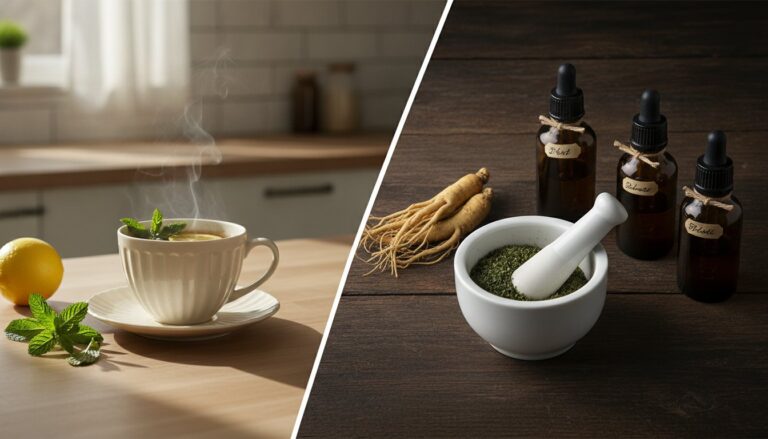
Is a cup of peppermint tea from your pantry truly the same as a clinically formulated herbal extract? Many people assume that natural wellness is a single, broad category, but the distinction between herbal medicine vs home remedies is fundamental to your safety and long-term vitality. While a kitchen staple might soothe a temporary discomfort, it lacks the diagnostic precision and synergistic potency of a professional formula designed for your specific constitution.
It’s natural to feel a sense of hesitation when faced with conflicting online advice or the recent 2026 shifts in FDA oversight for dietary supplements. You want the benefits of nature without the anxiety of trial and error. This article clarifies exactly how to choose between simple home care and a structured therapeutic approach. We’ll explore the safety profiles of medicinal herbs and provide the criteria you need to find a reliable mentor for your health journey in Bergen County. By understanding these differences, you can move forward with the confidence that your wellness choices are both informed and effective.
Key Takeaways
- Distinguish between the casual use of kitchen staples for mild relief and the clinical application of professional formulas for complex health concerns.
- Learn how professional herbalists utilize the “entourage effect” to create balanced, potent treatments that exceed the efficacy of single-ingredient remedies.
- Understand the critical safety differences of herbal medicine vs home remedies, including how to identify potential herb-drug interactions and why “natural” does not always equate to “safe.”
- Apply the “72-hour rule” to determine when a persistent symptom requires a transition from simple home care to expert herbal consultation.
- Discover how professional guidance in Bergen County can bridge the gap between ancient botanical wisdom and your modern wellness requirements.
Defining the Difference: Herbal Medicine vs. Home Remedies
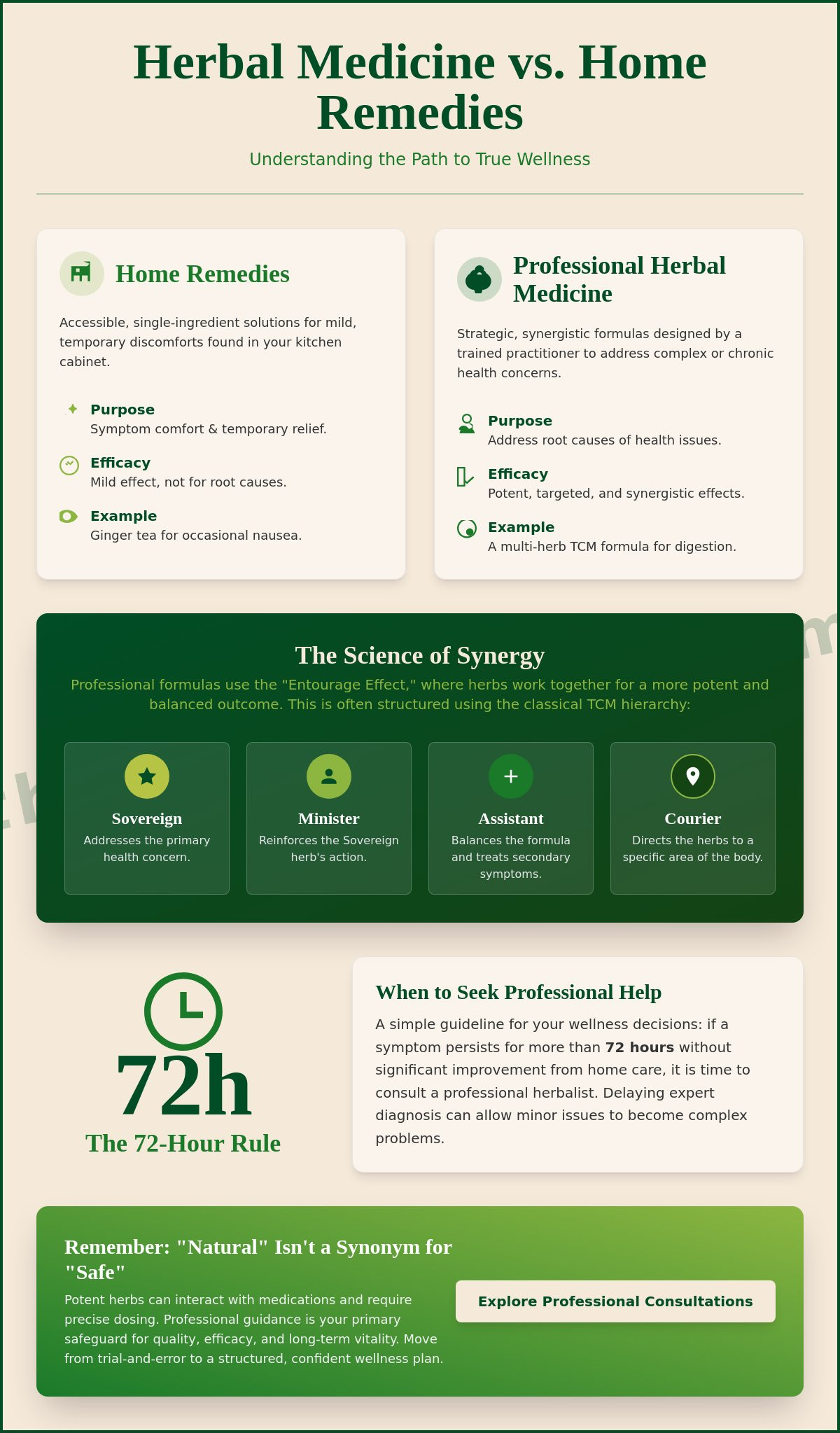
To the casual observer, the line between a kitchen pantry and a medicinal dispensary might seem blurred. However, the distinction between herbal medicine vs home remedies is a matter of both depth and clinical intent. Home remedies are generally accessible, utilizing common ingredients to address mild, self-limiting symptoms. In contrast, professional herbal medicine involves the strategic application of plant-derived substances to achieve specific therapeutic outcomes under the guidance of a trained practitioner. This separation is vital for anyone seeking to transition from simple symptom management to true systemic wellness.
What Qualifies as a Home Remedy?
A home remedy is defined by its simplicity and immediate availability. You likely use these daily without a second thought. Common examples include using honey to coat a dry cough or ginger to settle occasional nausea. This “kitchen cabinet” philosophy focuses on comfort and temporary relief. While these methods are valuable for minor upsets, they aren’t designed to address the underlying root causes of chronic or complex health conditions. Relying solely on these accessible solutions for persistent issues can often delay necessary professional intervention.
The Scope of Professional Herbal Medicine
Professional herbal medicine represents a more rigorous discipline that bridges the gap between historical Traditional medicine
The Science of Synergy: Why Professional Formulas Excel
The effectiveness of a botanical intervention often depends on synergy rather than the strength of a single ingredient. This is a primary differentiator when comparing herbal medicine vs home remedies. While a single-herb home remedy like chamomile tea provides gentle relaxation, a professional formula combines multiple plants to achieve a specific systemic shift. This interaction is known as the “entourage effect,” where the various chemical constituents of different plants enhance one another’s benefits while neutralizing potential side effects. Professional herbalists don’t just pick herbs at random; they construct a formula like a master architect builds a stable home.
Traditional Chinese Medicine (TCM) Perspectives
Central to this discipline is the classical hierarchy known as Jun-Chen-Zuo-Shi, or Sovereign, Minister, Assistant, and Courier. In this framework, the Sovereign herb addresses the core health issue, while the Minister herb reinforces its action. The Assistant herb is crucial for balancing the formula, often mitigating harshness or addressing secondary symptoms. Finally, the Courier herb directs the medicinal properties to the specific area of the body that requires attention. This sophisticated method of Understanding Chinese Herbal Formulas ensures that the treatment is perfectly calibrated to an individual’s unique pattern of disharmony. It’s a level of precision that a simple home remedy cannot replicate.
Modern Clinical Herbalism
Modern science validates these traditional structures by examining how active compounds, such as alkaloids and flavonoids, work in concert. While a single-herb supplement found in a grocery store might provide a high dose of one compound, it often lacks the regulatory substances found in a synergistic formula. It’s essential for patients to understand how herbal supplements are regulated in the United States. Since these products are treated as dietary supplements rather than pharmaceuticals, the expertise of a practitioner becomes the primary safeguard for quality and efficacy.
Clinical herbalism moves beyond the “what” of a symptom to the “why” of the underlying imbalance. By utilizing professional diagnostics before any prescription is made, we ensure that the herbs support the body’s natural vitality without causing further discord. If you are ready to move toward a more structured wellness plan, you can explore professional herbal consultations to see how synergy can transform your health. This evidence-based approach focuses on root-cause resolution, providing a sustainable path toward long-term recovery that mere symptom suppression often misses.
Safety and Efficacy: Addressing the ‘Natural’ Misconception
A common fallacy in the wellness community is the belief that because a substance is derived from nature, it’s inherently safe. This misconception often leads to confusion when evaluating herbal medicine vs home remedies. While a home remedy might seem benign, many medicinal plants contain potent chemical compounds that require careful handling. The Mayo Clinic has long cautioned that “natural” is not a synonym for “safe,” particularly when these substances are used without the oversight of a trained professional. True botanical safety requires an understanding of the plant’s chemistry and its specific impact on human physiology.
One of the most significant risks involves potential herb-drug interactions. Patients often neglect to disclose their supplement use to their primary care providers, assuming these items are separate from their pharmaceutical regimen. However, certain herbs can significantly alter how the body processes conventional medications, either by neutralizing their effect or dangerously increasing their potency. Research published by the National Center for Biotechnology Information highlights that herbal products are often believed to be free from undesirable side effects, yet the reality is that toxicity can occur if the dosage or botanical identity is incorrect. This underscores the necessity of professional consultation over guesswork.
Common Risks of Unregulated Home Treatments
Self-diagnosing with potent medicinal herbs can lead to unintended consequences. Home treatments often rely on casual measurements, which can result in incorrect dosages that are either ineffective or subtly harmful. When individuals attempt to navigate herbal medicine vs home remedies on their own, they often overlook the importance of standardized extracts. Some common plants, while helpful in specific contexts, can become toxic if consumed in excess or for too long. Beyond this, low-grade commercial products found in grocery stores may suffer from contamination with heavy metals, mold, or pesticides. Professional guidance is essential to mitigate these adverse reaction risks and ensure the botanical’s profile matches the patient’s needs.
Identifying Professional-Grade Herbal Medicine
Transitioning to professional herbal medicine involves seeking out products that meet rigorous purity standards. These are typically “practitioner-only” brands that undergo extensive third-party testing to verify their chemical composition and ensure they’re free from adulterants. In Bergen County, Licensed Acupuncturists are trained to assess the safety of these formulas within the context of a patient’s entire health history. Professional-grade herbal medicine is defined as a botanical substance that has been verified through standardized testing to be free of contaminants while maintaining a consistent concentration of active therapeutic compounds. By choosing these vetted sources, you ensure that your path to wellness is built on a foundation of clinical integrity rather than marketing claims.
When to Choose a Home Remedy vs. Professional Herbal Support
Deciding between a pantry staple and a clinical formula requires a high degree of discernment. While many individuals begin their natural health journey with simple kitchen solutions, understanding when to transition from herbal medicine vs home remedies is a critical skill for effective health stewardship. This choice shouldn’t be based on convenience alone; rather, it should be informed by the severity, duration, and complexity of the symptoms you’re experiencing. A misplaced reliance on a mild remedy for a systemic issue can lead to prolonged discomfort, just as a potent medicinal formula might be unnecessary for a minor, passing upset.
A practical benchmark for this decision is the “72-hour rule.” If an acute symptom, such as a mild cough or temporary digestive sluggishness, doesn’t show measurable improvement within three days of home care, it likely indicates an underlying imbalance that requires professional assessment. While home care focuses on immediate, surface-level comfort, professional herbal medicine addresses the deeper physiological patterns that allow these symptoms to persist. Recognizing this clinical threshold ensures that you don’t overlook a condition that requires diagnostic precision.
Situations Best Suited for Home Remedies
Home remedies are most effective when applied to mild, acute issues that don’t involve chronic systemic dysfunction. For example, using a ginger infusion for occasional motion sickness or a honey-based syrup for a scratchy throat provides immediate, low-risk relief. These kitchen staples are excellent for general wellness maintenance and dietary support, acting as the first line of defense for minor scrapes or seasonal transitions. They’re valuable tools for daily vitality, provided they’re used within their limited scope of temporary symptom management.
When to Consult a Licensed Herbalist
Professional intervention becomes necessary when health concerns move beyond the acute phase into chronic or recurring patterns. For those managing persistent gut issues, seeking specialized Herbal Remedies for Digestive Health is far more effective than relying on occasional antacids or teas. A licensed practitioner can identify whether the issue stems from inflammation, enzyme deficiency, or microbial imbalance, which a simple home remedy cannot do. Similarly, building long-term resilience requires an understanding of How to Use Herbs for Immune System Support through formulas that modulate, rather than just stimulate, the body’s natural defenses.
Complex conditions involving hormonal transitions or chronic inflammatory responses also demand the diagnostic expertise of a professional. These issues often require a combination of multiple herbs that work in harmony to restore systemic balance. If you find yourself caught in a cycle of recurring symptoms, it’s time to move beyond the kitchen cabinet. You can schedule a professional herbal consultation to receive a personalized health plan that bridges the gap between traditional wisdom and your specific modern needs.
Professional Herbal Medicine in Northern New Jersey
Since 1995, The Oriental Natural Herbs has served as a cornerstone of botanical wellness in Bergen County. Our legacy is built upon a deep commitment to community vitality and the precise application of natural substances. While the internet offers an overwhelming volume of conflicting advice regarding herbal medicine vs home remedies, our center provides a stable, authoritative environment where tradition meets modern clinical standards. We believe that true health isn’t found in a generic bottle on a grocery shelf, but in a carefully calibrated strategy that respects your body’s unique requirements.
Michael Kim, L.Ac., leads our practice with a focus on bridging ancient wisdom and contemporary health needs. His expertise allows patients to move beyond the limitations of “kitchen cabinet” self-treatment. By combining high-quality herbal retail with professional consultations, we ensure that every individual receives a formula that is both safe and effective. We take great pride in serving the diverse communities of Fort Lee, Cliffside Park, and Teaneck, acting as a reliable mentor for those seeking a more purposeful approach to their lifestyle.
Why Local Expertise Matters for Your Health
Choosing a local practitioner offers a level of personalization that generic online shopping simply cannot replicate. When you visit our Cliffside Park location, you aren’t just purchasing a product; you’re engaging in a professional dialogue about your long-term wellness. We understand the specific health challenges faced by our New Jersey community, from seasonal environmental stressors to the fast-paced demands of local life. This geographic and personal context allows us to refine your treatment plan with a level of detail that ensures the herbs you consume are perfectly aligned with your environment and constitution.
Taking the Next Step in Your Wellness Journey
Transitioning from casual home remedies to a structured herbal protocol is a significant milestone in your natural health journey. While a cup of tea might offer temporary comfort, a custom medicinal formula provides the systemic support necessary for lasting change. These professional-grade protocols are designed to address the root causes of disharmony, moving you toward a state of balanced vitality. If you’re ready to experience the difference that clinical expertise makes, we invite you to take the next step toward informed, professional care. You can consult with a Licensed Acupuncturists at The Oriental Natural Herbs to begin developing a custom strategy tailored to your specific health goals.
Empowering Your Wellness with Professional Guidance
Transitioning from kitchen-based relief to a clinical protocol marks a significant shift toward systemic health. Understanding the fundamental nuances of herbal medicine vs home remedies allows you to use nature’s tools with greater precision and safety. While home care offers immediate comfort for minor upsets, professional-grade formulas provide the chemical synergy required to address root causes rather than just masking surface symptoms. This distinction is the key to moving beyond temporary fixes toward sustainable, long-term vitality.
Since 1995, The Oriental Natural Herbs has served as a reliable resource for the Bergen and Union County communities. Led by Michael Kim, a Licensed Acupuncturist and Diplomate of Oriental Medicine, our practice specializes in high-quality, professional-grade herbal formulas that meet the highest standards of purity. You don’t have to navigate the complexities of natural health through trial and error. We invite you to Discover Professional Herbal Solutions at The Oriental Natural Herbs and take a proactive step toward your well-being. We look forward to supporting your journey toward a more balanced and vibrant life.
Frequently Asked Questions
Is herbal medicine safer than pharmaceutical drugs?
Safety is not determined by whether a substance is natural or synthetic but by its application and dosage. While botanical substances are derived from nature, they contain active chemical compounds that can cause side effects or interact with conventional medications. Professional guidance is essential to ensure that a natural treatment is appropriate for your specific health history and does not cause unintended discord in your system.
What is the most effective home remedy for immediate relief?
The most effective remedy depends entirely on the specific acute symptom you are experiencing. For instance, ginger is highly effective for settling mild nausea, while honey is a reliable choice for coating a scratchy throat. These kitchen staples are excellent for providing immediate, low-risk comfort for minor issues, but they aren’t designed to resolve deep-seated or chronic physiological imbalances.
How do I know if an herbal medicine is high quality?
High-quality herbal products are distinguished by rigorous third-party testing and the use of standardized extracts. You should seek out formulas that have been verified for purity, ensuring they’re free from contaminants like heavy metals, pesticides, and mold. Professional-grade medicines are typically available through licensed practitioners who can guarantee the botanical identity and therapeutic potency of the ingredients.
Can I use herbal medicine and home remedies together?
You can often integrate both approaches, provided you understand the functional distinction between herbal medicine vs home remedies. A home remedy might offer immediate relief for a temporary discomfort, while a professional herbal protocol addresses the underlying root cause of your health concern. It’s vital to disclose all substances you’re using to your practitioner to ensure they work in harmony without overlapping effects.
Do I need a prescription for professional herbal medicine?
In the United States, herbal products are regulated as dietary supplements and don’t require a traditional medical prescription. However, many professional-grade formulas are “practitioner-only,” meaning they are designed to be dispensed after a clinical evaluation. This professional oversight ensures that the specific botanical properties are correctly matched to your unique constitution and health requirements.
How long does it take for herbal medicine to show results?
The timeline for results depends on whether you’re treating an acute symptom or a chronic condition. Acute issues may show improvement within a few hours or days, whereas chronic systemic imbalances often require several months of consistent use to achieve lasting change. This methodical progression allows the body to restore its natural balance through steady, sustainable physiological shifts.
Can herbal medicine help with chronic acid reflux?
Professional herbal medicine is highly effective for managing chronic digestive issues by addressing the root cause of the irritation. While a home remedy like apple cider vinegar might offer temporary relief for some, a clinical formula works to modulate stomach acid and support the integrity of the digestive lining. This approach focuses on long-term resolution rather than simply masking the recurring discomfort.
Where can I find a licensed herbalist in Bergen County, NJ?
You can find expert guidance at The Oriental Natural Herbs in Cliffside Park, where we have served the Northern New Jersey community since 1995. Our practice is led by Michael Kim, a Licensed Acupuncturist and Diplomate of Oriental Medicine. We provide personalized consultations to help you navigate the differences between herbal medicine vs home remedies for your specific wellness journey.