
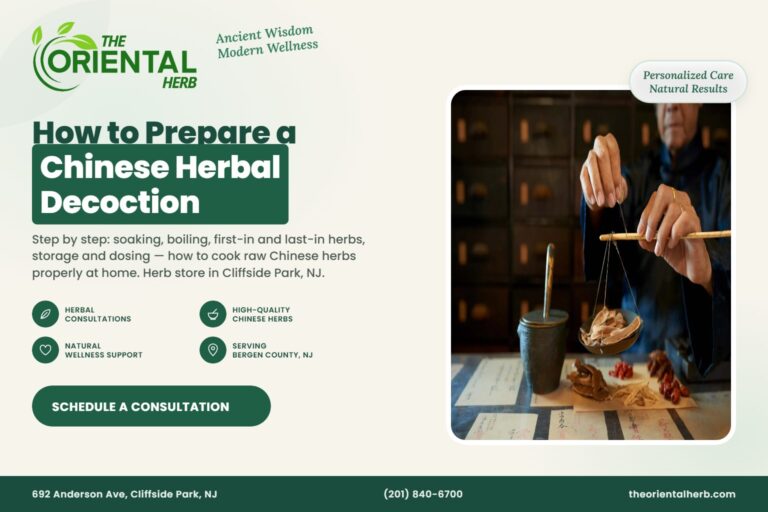
Raw herbs cooked into a decoction – tang in Chinese – are the oldest and, many practitioners believe, the most effective way to take Chinese herbal medicine. The formula can be adjusted gram by gram, the dose is higher than pills or granules, and the warm liquid is absorbed quickly. The only disadvantage is that you have to cook it. If you have just picked up a bag of herbs from our Cliffside Park store and are staring at a pile of roots, bark and flowers, this is the guide: how to prepare a Chinese herbal decoction properly, step by step.
What You Need
- A pot – ceramic, glass, enamel or stainless steel. Traditionally a clay pot. Do not use iron, aluminum or copper, which react with the herbs.
- Filtered or spring water
- A strainer and a glass jar or jug for storing the finished liquid
- Your herb packet(s) – one packet is usually one day’s dose, cooked twice
Step 1: Soak
Empty one packet into the pot. Add enough cold water to cover the herbs by about 1–2 inches (usually 3–5 cups). Let them soak for 30–60 minutes. Soaking softens dense roots and bark so their constituents release during cooking. Do not rinse the herbs first – you would wash away the powders and small seeds.
Step 2: First Boil
Bring the pot to a boil over high heat, then reduce to a gentle simmer with the lid slightly ajar. Simmer for the time your practitioner specifies – usually 30–45 minutes for tonic formulas (roots and barks) and 15–20 minutes for formulas treating colds and flu (light flowers and leaves). The liquid should reduce to about 1–1½ cups. Strain into your jar.
Step 3: Second Boil
Return the herbs to the pot, add fresh water to cover (2–3 cups) and simmer again for 20–30 minutes. Strain and combine the two batches. Combining both cookings gives a consistent strength; the first boil alone is stronger than the second.
Step 4: Divide and Drink
Divide the combined liquid into two or three doses and drink warm, typically before or between meals, morning and evening. Reheat gently – do not microwave if you can avoid it, and never boil the finished decoction again. Refrigerate what you are not drinking immediately; it keeps for two to three days.
Special Instructions You May See on Your Packet
- “Cook first” (xian jian) – minerals, shells and toxic-when-raw herbs such as Shi Gao, Mu Li or Fu Zi are boiled 20–60 minutes before the rest is added.
- “Add at the end” (hou xia) – aromatic herbs such as Bo He, Sha Ren or Xin Yi Hua go in for the last 5 minutes so their oils are not lost.
- “Wrap” (bao jian) – fine seeds and fuzzy herbs such as Che Qian Zi or Xuan Fu Hua are tied in a cloth bag so they do not cloud the liquid.
- “Cook separately” (ling jian) – precious herbs such as Ren Shen (ginseng) are cooked alone and the liquid added.
- “Dissolve” (yang hua) – gelatins such as E Jiao are melted into the hot strained liquid.
- “Take with” (chong fu) – powders such as San Qi are stirred into the finished decoction.
Tips for Better Results
- Cook on the day you drink, or cook two days at once and refrigerate.
- Expect a bitter, earthy taste – a small piece of dried tangerine peel or a date can be added if your practitioner agrees. Avoid adding sugar.
- Do not drink decoctions ice-cold; warm liquid is easier on digestion.
- Keep tea, coffee and raw, cold foods away from your herb doses by about an hour.
- Tell your practitioner if you notice nausea, loose stools or any reaction – formulas are easily adjusted.
Decoction vs Granules vs Pills
Decoctions are the strongest and most adjustable, ideal for acute problems and complex cases. Granules (concentrated extracts dissolved in hot water) are far more convenient and nearly as effective for most chronic conditions. Pills are convenient for long-term tonics. We stock all three; your practitioner will suggest the right form. Read more in our article on herbal tea versus extracted tablets.
Safety
Only cook herbs prescribed for you, in the amounts given. Some herbs are toxic if under-cooked (notably Fu Zi), which is why “cook first” instructions matter. Store herbs in a cool, dry place away from pests, and discard any that smell musty or show mold.
Frequently Asked Questions
Can I use a slow cooker or an electric herb cooker?
Yes – electric ceramic herb cookers are popular and convenient. A slow cooker on high for 2–3 hours also works for tonic formulas, though not for light cold-and-flu formulas.
How much water should I use?
Enough to cover the herbs by 1–2 inches for the first boil; a little less for the second. The exact amount depends on how bulky the herbs are.
Where can I buy raw Chinese herbs in New Jersey?
Our Chinese herb store in Cliffside Park dispenses raw herbs, granules and patent formulas, and can prepare custom formulas after a consultation.
Talk to a Chinese herbal practitioner in Cliffside Park, NJ. The Oriental Herb has served Bergen County since 1995 with personalized herbal consultations and high-quality Chinese herbs. Book a consultation, call (201) 840-6700, or visit our Chinese herb store at 692 Anderson Ave.
This article is for educational purposes only and is not medical advice. Chinese herbs are not a replacement for diagnosis or treatment from your physician. Always tell your doctor and your herbalist about every medication and supplement you take.