
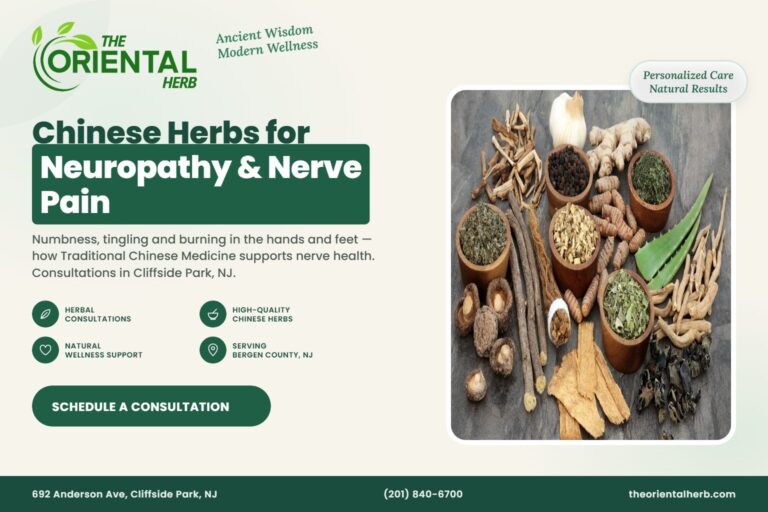
Peripheral neuropathy – numbness, tingling, burning or pins-and-needles in the feet and hands – is one of the most frustrating conditions to live with. It is most often caused by diabetes, but chemotherapy, vitamin B12 deficiency, alcohol, thyroid problems and simple aging can all damage the small nerves of the extremities. Conventional treatment focuses on controlling the cause and managing pain. Chinese herbs for neuropathy aim at something slightly different: restoring the flow of Qi and Blood to the extremities so the nerves are nourished again.
Neuropathy in Chinese Medicine
TCM calls numbness ma mu and treats it as a sign that Qi and Blood are failing to reach the limbs. The classical explanation is: “When Blood does not nourish the sinews, there is numbness; when Qi does not move, there is tingling.” The main patterns are:
- Qi and Blood deficiency – numbness that is worse when tired, pale complexion, fatigue, weak pulse. Common after chemotherapy or long illness.
- Blood stasis – fixed burning or stabbing pain, worse at night, dark or purple tongue. Common in long-standing diabetic neuropathy.
- Cold-damp obstruction – numbness with cold, heavy feet, worse in winter.
- Yin deficiency with heat – burning soles at night, dry mouth, restlessness.
Chinese Herbs Commonly Used for Neuropathy
Huang Qi (Astragalus)
The leading Qi tonic. In large doses it is the chief herb of Bu Yang Huan Wu Tang, a formula developed for numbness and weakness after stroke and now widely used for neuropathy.
Dang Gui (Angelica) and Ji Xue Teng (Spatholobus)
Nourish and move Blood to the extremities. Ji Xue Teng (“chicken blood vine”) is particularly valued for numbness in the hands and feet.
Gui Zhi (Cinnamon Twig)
Warms the channels and guides other herbs to the limbs. The classic formula Huang Qi Gui Zhi Wu Wu Tang pairs it with Astragalus for numbness from deficiency and cold.
Chuan Xiong, Hong Hua (Safflower) and Tao Ren (Peach Kernel)
Blood-moving herbs used when pain is fixed and burning.
Di Long (Earthworm)
An animal product used in TCM to unblock the channels; practitioner-only but a frequent addition for stubborn numbness.
Sang Zhi (Mulberry Twig) and Luo Shi Teng (Star Jasmine Stem)
Gentle channel-opening herbs for tingling in the arms and hands.
Classic Formulas
- Huang Qi Gui Zhi Wu Wu Tang – for numbness with cold and fatigue.
- Bu Yang Huan Wu Tang – for numbness and weakness with Blood stasis, especially in the lower limbs.
- Shen Tong Zhu Yu Tang – for severe burning nerve pain.
If You Have Diabetes
Diabetic neuropathy improves most when blood sugar is well controlled, and herbs are chosen to support – never replace – that. Our page on Chinese herbs for blood sugar support covers the formulas used alongside medication and the hypoglycemia precautions that apply. Check your feet daily; numbness means you may not feel a wound.
Self-Care From TCM
- Warm foot soaks each evening (plain warm water, or with ginger slices) to move Blood to the feet.
- Keep extremities warm in winter.
- Walk daily if your feet allow – movement is the simplest way to move Qi.
- Avoid alcohol, which both damages nerves and worsens dampness.
Safety
- Blood-moving herbs can interact with anticoagulants and should be paused before surgery.
- If you are receiving chemotherapy, coordinate herbal treatment with your oncology team.
- Sudden numbness on one side of the body, facial drooping or trouble speaking is a possible stroke – call 911.
Frequently Asked Questions
Can nerve damage be reversed with Chinese herbs?
Mild to moderate neuropathy, especially from deficiency, often improves in sensation and pain. Severe long-standing damage responds more slowly, and the realistic goal is less pain and better function.
How long until I notice a change?
Most people notice warmer feet and less tingling within four to eight weeks; deeper change takes three to six months.
Is this the same as joint pain treatment?
Neuropathy is nerve pain, not joint pain, and the formulas differ. For arthritis see our Chinese herbs for joints and arthritis page.
Talk to a Chinese herbal practitioner in Cliffside Park, NJ. The Oriental Herb has served Bergen County since 1995 with personalized herbal consultations and high-quality Chinese herbs. Book a consultation, call (201) 840-6700, or visit our Chinese herb store at 692 Anderson Ave.
This article is for educational purposes only and is not medical advice. Chinese herbs are not a replacement for diagnosis or treatment from your physician. Always tell your doctor and your herbalist about every medication and supplement you take.