
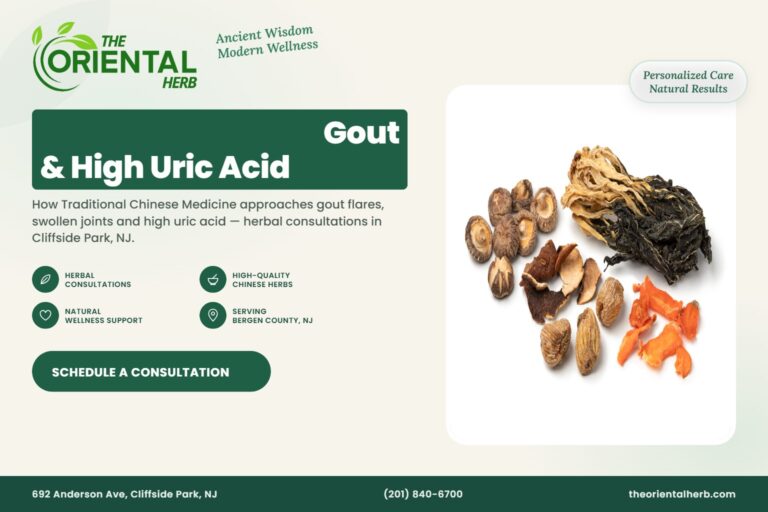
A gout attack is hard to forget: a big toe or ankle that becomes red, hot, swollen and so tender that a bedsheet hurts. Gout is caused by uric acid crystals forming in the joint, and it is increasingly common in New Jersey as diets grow richer in meat, seafood, alcohol and sugary drinks. Medication such as allopurinol and colchicine is effective and should not be stopped without medical advice – but many people also want to reduce how often flares happen and support their body between attacks. That is where Chinese herbs for gout come in.
Gout in Chinese Medicine
TCM classifies gout under Bi syndrome (painful obstruction), and the acute flare is almost always a pattern of damp-heat: dampness (from rich food, alcohol and weak digestion) combines with heat and settles in the lower joints, where it blocks the flow of Qi and Blood. Over years, dampness and stasis thicken into what TCM calls phlegm and Blood stasis – the tophi and chronic joint damage of long-standing gout.
Between attacks, practitioners look for the reason dampness keeps forming, usually Spleen Qi deficiency (weak digestion) or Kidney deficiency (poor elimination).
Chinese Herbs Commonly Used for Gout
Tu Fu Ling (Smilax glabra)
Perhaps the best-known Chinese herb for gout. It drains dampness, clears toxins and is traditionally used for joint pain with swelling. Many modern Chinese gout formulas are built around it.
Yi Yi Ren (Coix Seed / Job’s Tears)
A food-grade herb that strengthens the Spleen while draining dampness through the urine. Often cooked as a porridge for people prone to gout.
Huang Bai (Phellodendron) and Cang Zhu (Atractylodes)
This pair, known as Er Miao San, is the classic combination for damp-heat in the lower body – red, hot, swollen joints.
Niu Xi (Achyranthes)
Guides the formula downward to the knees, ankles and feet, and moves Blood in the lower limbs.
Qin Jiao (Gentiana macrophylla) and Fang Ji (Stephania)
Classic wind-damp herbs used for joint swelling and stiffness.
Che Qian Zi (Plantain Seed) and Ze Xie (Alisma)
Promote urination to help the body clear dampness – in modern terms, supporting the elimination of uric acid.
Classic Formulas
- Si Miao San (Four Marvel Powder) – Huang Bai, Cang Zhu, Yi Yi Ren and Niu Xi; the standard formula for damp-heat in the lower joints and the starting point for most gout prescriptions.
- Xuan Bi Tang – for hot, painful, swollen joints with fever and heaviness.
- Shen Ling Bai Zhu San – between attacks, to strengthen the Spleen and stop dampness from forming.
Food Therapy for High Uric Acid
TCM dietary advice for gout lines up closely with modern guidance:
- Cut back on organ meats, shellfish, red meat, beer and sugary drinks – all “damp-heat” foods.
- Eat cooked, light meals: winter melon, celery, cucumber, mung beans and Job’s tears porridge.
- Drink plenty of warm water through the day to flush dampness.
- Cherries and chrysanthemum tea are traditional gout-friendly choices.
Safety and When to See a Doctor
- A first attack of a hot, swollen joint needs a medical diagnosis – septic arthritis can look similar and is an emergency.
- Keep taking prescribed uric-acid-lowering medication; herbs support it, they do not replace it.
- Diuretic herbs can interact with prescription diuretics and affect potassium; tell your practitioner about all medications.
- Some Chinese patent medicines sold online for gout have been found to contain undeclared drugs. Buy from a reputable source and avoid products with no ingredient list.
Frequently Asked Questions
Can Chinese herbs lower uric acid?
Several herbs used in TCM gout formulas have been studied for effects on uric acid, but results vary and medication remains the proven approach. The strongest benefit of TCM is reducing the damp-heat pattern – diet, digestion and elimination – that makes flares more frequent.
Should I take herbs during a flare or between flares?
Both, but with different formulas: cooling, draining herbs during a flare and Spleen-strengthening herbs between flares.
Is gout related to joint pain in general?
Gout is one specific cause. For arthritis and general joint pain, see our page on Chinese herbs for joints and arthritis.
Talk to a Chinese herbal practitioner in Cliffside Park, NJ. The Oriental Herb has served Bergen County since 1995 with personalized herbal consultations and high-quality Chinese herbs. Book a consultation, call (201) 840-6700, or visit our Chinese herb store at 692 Anderson Ave.
This article is for educational purposes only and is not medical advice. Chinese herbs are not a replacement for diagnosis or treatment from your physician. Always tell your doctor and your herbalist about every medication and supplement you take.