
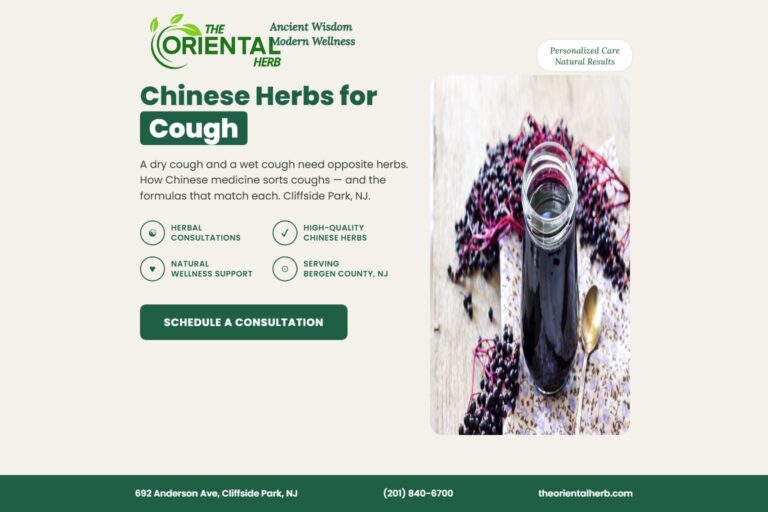
“Cough syrup” treats every cough the same way. Chinese medicine would call that a mistake, because a dry, tickly cough and a wet, rattling one are opposite problems – one needs moistening, the other needs drying – and the same bottle cannot do both. Chinese herbs for cough are therefore sorted by type first. Below are the four coughs we see most often in our Cliffside Park store, the herbs for each, and the point at which a cough stops being a herbal matter. The lungs in general are covered on our page on Chinese herbs for lung and respiratory health.
1. The dry, tickly cough
Little or no phlegm, a scratchy throat, worse in dry heated rooms and in the evening, sometimes with a hoarse voice. In TCM this is dryness injuring the lungs – common in winter and after a fever. Herbs: Chuan Bei Mu (Fritillaria), Mai Men Dong (Ophiopogon), Sha Shen (Glehnia), Bai He (Lily bulb), Pi Pa Ye (Loquat leaf). Formula: Sang Xing Tang or Bai He Gu Jin Tang. A pear stewed with a little rock sugar and Chuan Bei Mu is the traditional home remedy and genuinely helps.
2. The wet, phlegmy cough
Lots of white or clear phlegm, a rattling chest, worse in the morning and after dairy or sweet food; often with a heavy body and poor appetite. This is phlegm-dampness. Herbs: Ban Xia (Pinellia), Chen Pi (tangerine peel), Fu Ling (Poria), Jie Geng (Platycodon), Xing Ren (Apricot kernel). Formula: Er Chen Tang with additions. Moistening herbs would make this cough worse – which is why the type matters.
3. The hot cough with yellow phlegm
Thick yellow or green phlegm, a sore throat, thirst, sometimes fever – usually an infection. Herbs: Huang Qin (Scutellaria), Yu Xing Cao (Houttuynia), Gua Lou (Trichosanthes fruit), Zhe Bei Mu. Formula: Qing Qi Hua Tan Wan. If there is fever, chest pain or shortness of breath, this is a doctor’s cough first.
4. The lingering cough after a cold
The cold is gone but the cough stays for weeks – dry, in fits, often at night or when talking. Usually a little residual wind with lung Qi that has not recovered. Herbs: Zi Wan (Aster), Kuan Dong Hua (Coltsfoot), Bai Bu (Stemona), Jie Geng, with Huang Qi to rebuild. Formula: Zhi Sou San. This is the cough we see most in late autumn, and it usually clears within one to two weeks of the right formula.
When a cough needs a doctor, not a herbalist
Any cough lasting more than three weeks without improving; coughing blood; fever above 102°F; shortness of breath, wheeze or chest pain; a cough in a smoker that changes character; night sweats with weight loss; or any significant cough in an infant or someone with heart or lung disease. Persistent cough can also be acid reflux or a blood pressure medication side effect – both treatable once identified.
FAQ
Can I take Chinese herbs for cough with antibiotics?
Yes; they address the phlegm and the lung tissue rather than the bacteria, and do not interfere with the antibiotic. Take them two hours apart.
Are these safe for children?
Many are, in child doses – the pear and Chuan Bei Mu remedy is a classic for children. Ask us; do not use adult formulas.
What about honey and loquat syrup from the store?
Pi Pa Gao (loquat syrup) suits the dry and lingering coughs. It is the wrong choice for a wet, phlegmy cough.
Talk to a Chinese herbal practitioner in Cliffside Park, NJ. The Oriental Herb has served Bergen County since 1995 with personalized herbal consultations and high-quality Chinese herbs. Book a consultation, call (201) 840-6700, or visit our Chinese herb store at 692 Anderson Ave.
This article is for educational purposes only and is not medical advice. Chinese herbs are not a replacement for diagnosis or treatment from your physician. Always tell your doctor and your herbalist about every medication and supplement you take.