
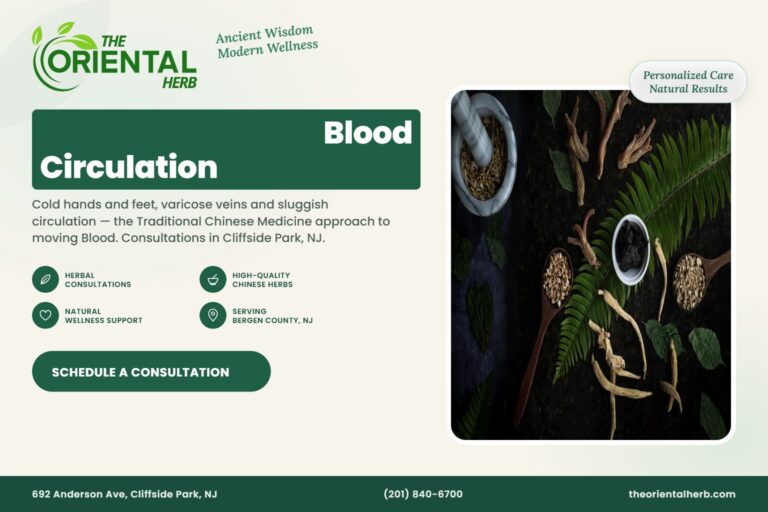
Cold hands and feet in a warm room. Legs that feel heavy by evening. Varicose veins, easy bruising, a dusky complexion, or pain that is fixed in one spot and worse at night. In Traditional Chinese Medicine (TCM) these are all signs of poor circulation – either Blood that is not being moved strongly enough, or Blood that has become stuck, a pattern TCM calls Blood stasis. Chinese herbs for blood circulation are among the most researched in the entire pharmacopeia, and several are now used in hospitals in China for cardiovascular conditions.
Circulation in Chinese Medicine
TCM says Qi moves Blood. If Qi is weak (fatigue, shortness of breath), Blood moves sluggishly. If Qi is stuck (stress, tension), Blood stagnates behind it. If the body is cold, Blood “congeals” like oil in winter. And if Blood itself is deficient, there is not enough of it to reach the extremities. Good circulation therefore needs enough Blood, enough Qi, enough warmth and free flow – and the right herbs depend on which is missing.
Signs of Blood Stasis
- Fixed, stabbing pain that is worse at night
- A purple or dark tongue, sometimes with dark spots
- Dark circles under the eyes, a dull complexion
- Varicose veins, spider veins, easy bruising
- Dark menstrual blood with clots
- Numbness or tingling in the limbs
Chinese Herbs Commonly Used for Circulation
Dan Shen (Salvia miltiorrhiza)
The most widely used Blood-moving herb in modern Chinese medicine, prescribed for chest discomfort, poor circulation and stasis pain.
Chuan Xiong (Ligusticum)
Moves both Qi and Blood and travels to the head – used for circulation-related headaches and dizziness.
Hong Hua (Safflower) and Tao Ren (Peach Kernel)
The classic pair for breaking up stasis; the core of Xue Fu Zhu Yu Tang.
Dang Gui (Angelica sinensis)
Both nourishes and moves Blood, making it ideal for people who are deficient and stagnant at once – cold, pale, and achy.
Gui Zhi (Cinnamon Twig) and Rou Gui (Cinnamon Bark)
Warm the channels; essential for the cold-type circulation problem with icy hands and feet.
Huang Qi (Astragalus)
Strengthens Qi so that it can push Blood to the periphery; used in large doses for weakness with numbness.
San Qi (Notoginseng)
Unique in both stopping bleeding and moving Blood; used for bruising and injury.
Classic Formulas
- Xue Fu Zhu Yu Tang – general Blood stasis with fixed pain, dark complexion and poor sleep.
- Dang Gui Si Ni Tang – cold hands and feet from cold and Blood deficiency.
- Bu Yang Huan Wu Tang – weakness and numbness from Qi deficiency and stasis.
- Gui Zhi Fu Ling Wan – stasis in the lower abdomen (fibroids, painful periods).
Daily Habits That Move Blood
- Move every hour – sitting still is the number-one cause of stagnation.
- Warm foot soaks and dry-brushing toward the heart.
- Ginger, cinnamon, turmeric and a little rice wine in cooking warm and move Blood.
- Avoid iced drinks, especially in winter.
Safety
Blood-moving herbs are the group most likely to interact with medication. Do not combine them with warfarin, clopidogrel or high-dose aspirin without medical supervision; stop them one to two weeks before surgery; and avoid them in pregnancy. Sudden leg swelling with pain, or chest pain with shortness of breath, needs emergency care.
Frequently Asked Questions
Which Chinese herb is best for cold hands and feet?
If the cause is cold and Blood deficiency, Dang Gui Si Ni Tang is the classic answer; if it is low energy, Astragalus-based formulas work better. A practitioner can tell the difference quickly.
Do these herbs help varicose veins?
They can reduce heaviness, aching and progression, though they will not remove existing veins.
How is this related to energy?
Closely – Qi moves Blood. If fatigue is your main issue, start with our Chinese herbs for energy page. For pain in the joints, see joints and arthritis.
Talk to a Chinese herbal practitioner in Cliffside Park, NJ. The Oriental Herb has served Bergen County since 1995 with personalized herbal consultations and high-quality Chinese herbs. Book a consultation, call (201) 840-6700, or visit our Chinese herb store at 692 Anderson Ave.
This article is for educational purposes only and is not medical advice. Chinese herbs are not a replacement for diagnosis or treatment from your physician. Always tell your doctor and your herbalist about every medication and supplement you take.