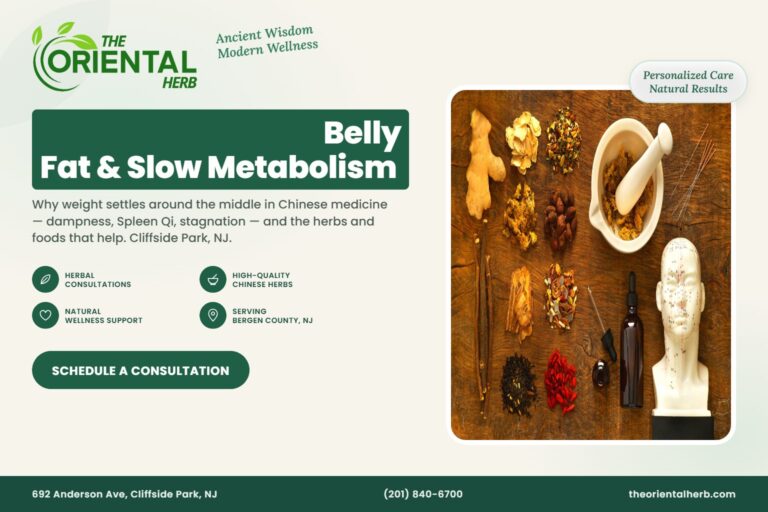
Weight that settles around the middle – and refuses to leave even when the rest of the body slims down – has a specific explanation in Traditional Chinese Medicine. Belly fat is where dampness collects. Chinese herbs for belly fat therefore do not try to “burn” fat; they correct the digestive weakness and stagnation that keep producing and holding it. This is a supporting article to our main guide on herbal remedies for weight loss.
Why Belly Fat, in TCM Terms
- Spleen Qi deficiency with dampness – the most common cause. A weak digestive system fails to transform food and fluids, and the excess collects as soft, heavy abdominal fat, bloating and fatigue after meals. Often worsened by cold drinks, sugar and dairy.
- Liver Qi stagnation – stress eating, bloating that comes and goes, weight gain during stressful periods; the “stress belly,” which modern medicine links to cortisol.
- Kidney Yang deficiency – a slow metabolism in the fullest sense: cold, tired, low thyroid-type picture, weight gain with fluid retention, common after 45.
- Phlegm-damp with heat – firm abdominal weight with high cholesterol and blood sugar, red face, strong appetite.
Chinese Herbs Commonly Used
Bai Zhu (Atractylodes) and Fu Ling (Poria)
Strengthen the Spleen and drain dampness – the foundation of every TCM weight formula.
Chen Pi (Tangerine Peel) and Shan Zha (Hawthorn)
Move Qi and digest fatty food; hawthorn is also used for cholesterol.
He Ye (Lotus Leaf)
A light, cooling leaf traditionally brewed as a slimming tea; drains dampness and “lifts” the sluggish metabolism.
Yi Yi Ren (Coix) and Chi Xiao Dou (Adzuki Bean)
Food-grade herbs for fluid retention and dampness; cooked as congee.
Chai Hu and Xiang Fu
For the stress-belly pattern – regulate Liver Qi and reduce stress eating.
Rou Gui (Cinnamon) and Gan Jiang (Dried Ginger)
Warm Yang and “turn the heat back on” in the cold, slow-metabolism pattern.
Formulas
- Shen Ling Bai Zhu San – Spleen deficiency with dampness.
- Fang Feng Tong Sheng San – phlegm-damp with heat and constipation (practitioner-prescribed).
- Xiao Yao San – stress-driven abdominal weight.
- Jin Gui Shen Qi Wan – Kidney Yang deficiency with fluid retention.
Food Rules for a Damp Belly
- Warm, cooked meals; breakfast is not optional in TCM.
- Cut cold drinks, smoothies, dairy, sugar and beer – the damp-makers.
- Ginger, cinnamon, cardamom and black pepper in cooking.
- Stop at 80% full; no food within three hours of bed.
- Walk after meals – movement transforms dampness.
Safety
Avoid “slimming” teas and capsules of unknown origin; several have been found to contain undeclared drugs or strong laxatives. Draining herbs can interact with diuretics. Unexplained weight gain with fatigue and cold intolerance should be checked for thyroid problems. See also dampness in Chinese medicine and Spleen Qi deficiency.
Frequently Asked Questions
Which Chinese herb burns belly fat?
None “burns” fat. Lotus leaf, hawthorn and Poria reduce the dampness and sluggish digestion that hold it, which is why results come with food changes, not instead of them.
How long does it take?
Bloating and heaviness improve in two to four weeks; measurable waist change usually takes two to three months.
Talk to a Chinese herbal practitioner in Cliffside Park, NJ. The Oriental Herb has served Bergen County since 1995 with personalized herbal consultations and high-quality Chinese herbs. Book a consultation, call (201) 840-6700, or visit our Chinese herb store at 692 Anderson Ave.
This article is for educational purposes only and is not medical advice. Chinese herbs are not a replacement for diagnosis or treatment from your physician. Always tell your doctor and your herbalist about every medication and supplement you take.